Zero emissions, maximum challenge: Acoustics in high-containment labs
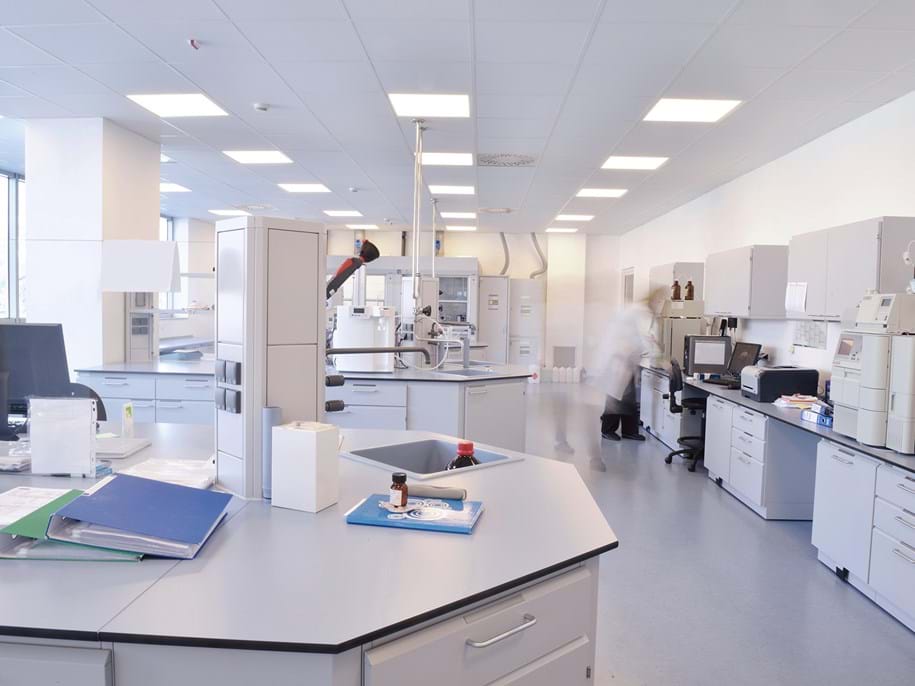
Designing acoustics for heavily contaminated laboratory environments presents a unique challenge. These are facilities where hazardous substances must be strictly contained, and the architectural demands – such as sealed spaces, magnetically locking steel and glass doors, and hard, easy-to-clean surfaces – are far from ideal for achieving acceptable reverberation times.
 Link copied



In cleanrooms used for manufacturing sensitive electronic equipment, it’s essential to prevent any contamination from entering. This is typically achieved using HEPA (High-Efficiency Particulate Air) filters to exclude airborne particles. Conversely, in contaminated laboratories, the same type of filters are used to prevent harmful substances from escaping. These environments also require negative air pressure to contain particles – just as cleanrooms use positive pressure to keep contaminants out.
Avoiding the “noisy box” effect
To maintain air pressure and filtration, labs are built with dense, sealed shells – hard walls, glazed sections, and steel-framed glass doors. While effective for containment, these materials reflect sound, creating noisy environments.
EU member states enforce strict regulations not only on the handling of hazardous substances but also on the design of facilities to meet environmental and safety standards. Given these constraints, acoustics must be considered early in the design process. Without proper treatment, these sealed rooms can become uncomfortably loud.
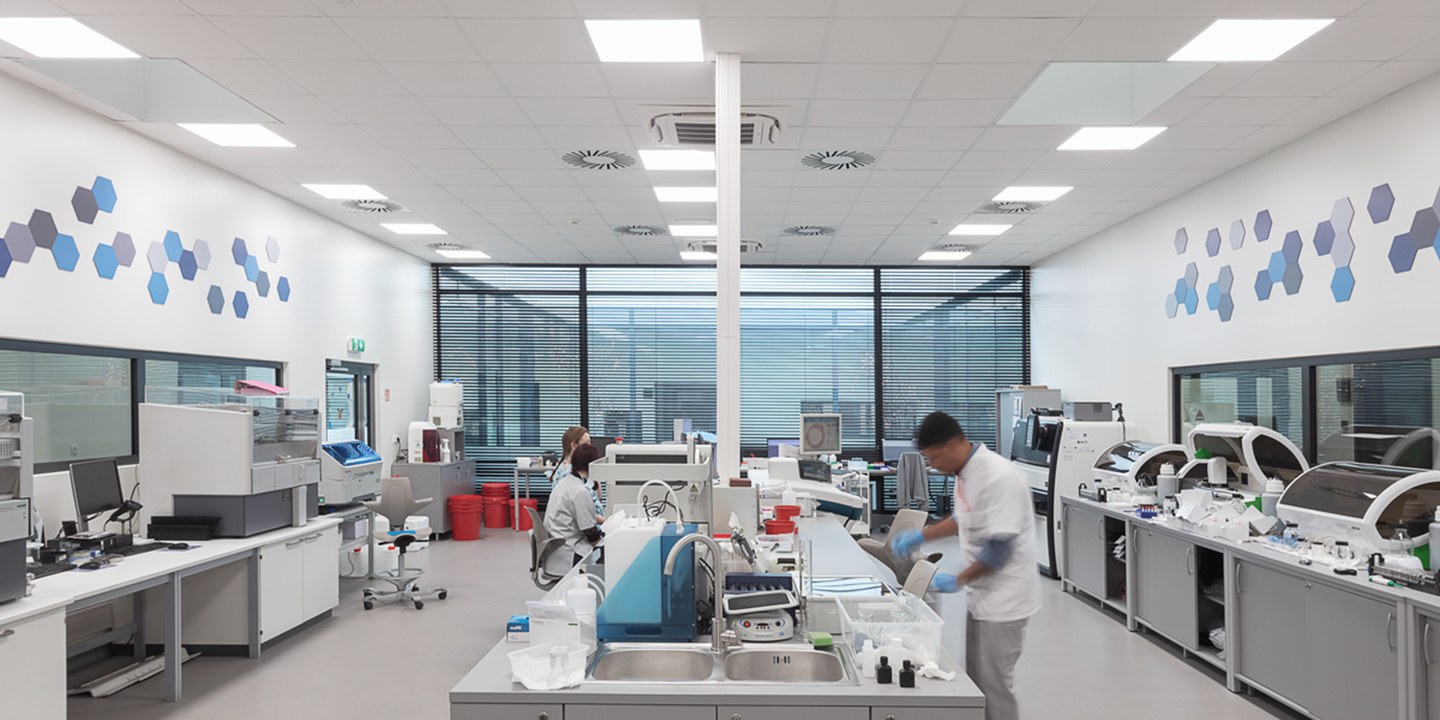
While cleanrooms are designed to keep particles out, high-containment labs are built to keep harmful substances in.
Smart acoustic integration
Due to restrictions on mechanical fixings, sound absorbers are often bonded directly to ceilings – navigating around lighting, cables, and ventilation. Acoustic ceilings are paired with high-performance wall absorbers to reduce flutter echoes.
Architectural plans guide the placement and quantity of absorbers needed to achieve optimal reverberation times. During installation, panel perimeters must be sealed with materials resistant to water, steam, and chemicals.
Why Sabine’s formula doesn’t work here
When planning acoustic treatments, it’s important to note that actual reverberation times in these environments often differ significantly from those predicted by Sabine’s formula. This was demonstrated in tests conducted in a small laboratory (58 m³) with concrete walls, floor, and ceiling, and no absorbers installed. The room, just 3.2 metres wide, exhibited reverberation times nearly double those calculated.
This discrepancy arises because Sabine’s formula assumes a perfectly diffused sound field, which is rarely the case in symmetrical, high-containment labs. Room modes – standing waves that prolong reverberation – can easily develop, and flutter echoes are common due to parallel surfaces.
These findings were used to extrapolate reverberation times in three different-sized labs. In the largest (315 m³), reverberation reached up to seven seconds.

The moral: in cases like this, reverberation times calculated using Sabine’s formula should not be trusted.
The right solution for critical spaces
To ensure safe, functional workspaces, acoustic ceilings and wall absorbers are essential. In high-containment labs, clear communication is critical.
Ecophon Hygiene Labotec™ Ds C1* is specifically designed for these demanding environments. It offers a full-coverage ceiling system with low particle emissions and resistance to wet cleaning and disinfection. With only vertical joints, it minimises dirt traps – making it ideal for laboratories where hygiene and safety are paramount.
This text is based on the article “The flip side of the clean room coin: acoustic design of high-containment laboratories”, by Alex Krasnic, Senior Acoustician.
*The product has been updated and is now available under a different name: Ecophon Hygiene Protec™ Ds.