
Simple fix brings relief to hospital kitchen staff
When noise in the hospital kitchen made communication difficult, staff at Tampere University Hospital found relief in a simple yet effective acoustic upgrade. With just a small number of sound-absorbing panels, a calmer, more comfortable workspace was created – proving that even modest changes can make a big difference.
 Link copied



Anyone who has been in a commercial kitchen knows how loud it can get. The larger the kitchen, the greater the risk of serious noise issues.
Tampere University Hospital, one of the largest hospitals in Finland, employs over 7,000 people and serves a catchment area of half a million residents. In the hospital’s kitchen – particularly in the dishwashing area – noise levels had become so high that Maintenance Engineer Ilkka Late turned to Ecophon for a solution. The noise wasn’t just irritating; it also made communication among staff difficult.
The solution was both simple and quick to implement, without disrupting kitchen operations.

Wall absorbers that are easy to remove for wall cleaning improved the room acoustics.

The staff can now communicate with each other without being bothered by noise.
Limited resources, impressive results
Just 15 m² of Ecophon Hygiene Foodtec™ Wall C3* sound absorbers were installed along the dishwashing conveyor belt. Mounted 40 mm from the wall, the panels can be easily removed for cleaning. The treated area covers 98 m² of floor space – more than six times the area covered by the absorbers – demonstrating that effective acoustic improvements can be achieved even with modest means.
Acoustic consultancy Helimäki measured key parameters before and after installation, confirming significant improvements:
- Reverberation Time (RT) decreased (see table).
- Early Decay Time (EDT) decreased (see table).
- Clarity (C80) increased (see table).
- Definition (D50) increased (see table).
- Speech Transmission Index (STI) improved
- Background Noise Level (LAeq) decreased
- Spatial Decay (DL2) improved from 3 dB to 6 dB
C80, D50, and STI are key indicators of speech intelligibility.
Results by octave band before and after installation of sound absorbers:
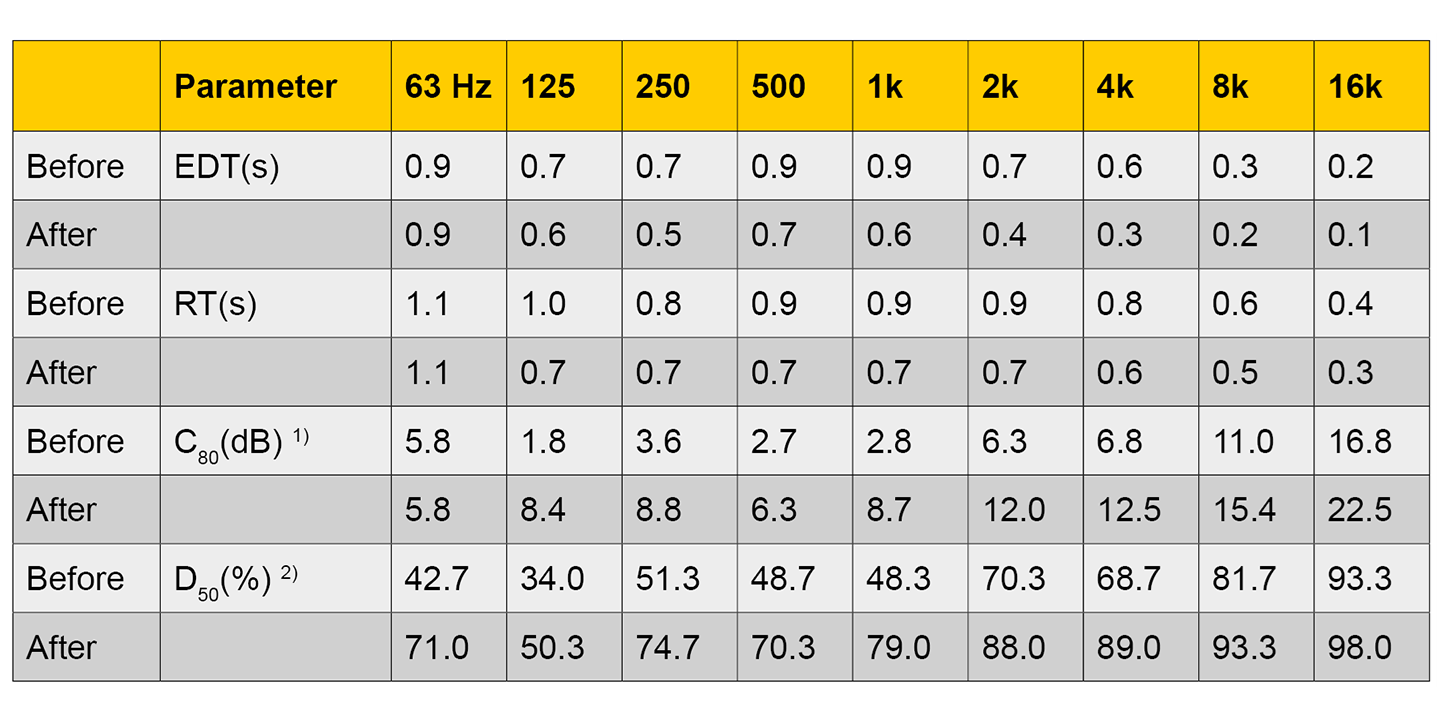
Note: 1) and 2) are related; if the one measurement is known, the other can be calculated. The difference is that C is expressed in dB while D is expressed in %, which is often preferred. It is easier to relate to a percentage, which stands for something relative, than to a dB-value.
Clearer communication for staff
The most important improvement was in speech clarity. At 500 Hz, clarity increased from 48.7% to 70.3%, and at 1,000 Hz, from 48.3% to 79%. Staff can now communicate more easily and report a noticeable improvement in the sound environment.
Encouraged by these results, Tampere University Hospital is planning further acoustic upgrades – next in line is the staff canteen adjacent to the kitchen.
*The product has been updated and is now available under a different name: Ecophon Hygiene Performance™ Wall.