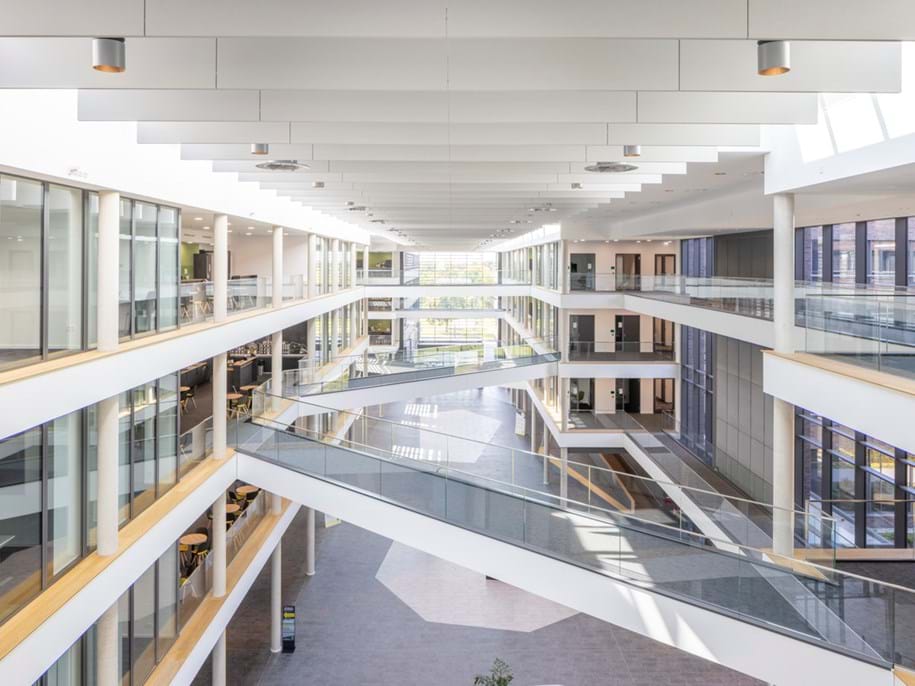
EDEKA Campus Minden
Project: EDEKA Campus Minden
Segment: Office
Country/city: Germany, Minden
Architect: EDEKA-MIHA Immobilien-Service GmbH
Photographer: Richard Stöhr
Production year: 2025
EDEKA Campus, Minden – A benchmark in modern workplaces & sustainable building
The EDEKA Campus in Minden is a landmark project that sets new standards in architecture, sustainability and contemporary work culture. Designed for around 2,000 employees, it combines innovative spatial concepts with high functionality and a strong focus on wellbeing.
Project overview
Covering approximately 123,000 m² (around 17 football fields) with 50,000 m² of usable space, the campus comprises five four-storey office buildings connected by a covered central walkway. It houses modern workplaces, meeting and training facilities, and a company restaurant with a generous outdoor terrace.
Sustainability features
Built to the KfW 55 energy-efficiency standard, the campus integrates a 350 kWp photovoltaic system, concrete core temperature control, automatic shading and advanced ventilation technology. Around 200 parking spaces with EV charging stations further support sustainable mobility.
Acoustic design and work environments
The campus is designed for activity-based working and desk sharing, providing 65 meeting rooms and flexible retreat zones for concentration or confidential discussions. To ensure optimal conditions across these diverse settings, acoustic planning was integrated from the earliest stages of design.
Room acoustics played a central role in shaping the overall work environment. The Activity Based Acoustic Design methodology developed by Ecophon, guided the process – considering the interplay between activity, people and space to create areas that support both focused and collaborative work. Early acoustic simulations and on-site testing were carried out to define suitable sound environments for different work modes.
A combination of Ecophon acoustic ceilings and tailored acoustic solutions ensures both visual coherence and acoustic comfort. These elements reduce sound propagation, improve speech intelligibility and contribute to a calm, balanced atmosphere throughout the buildings.
Collaboration with SoundComfort through measurements, simulations and workshops made it possible to fine-tune acoustic performance to the architectural design. The insights gained helped introduce all 2,000 employees to the new workspace concept and supported a smooth transition to the modern campus environment.
Conclusion
The EDEKA Campus exemplifies how architectural quality, sustainability and acoustic excellence can work hand in hand. It stands as a model for the workplace of tomorrow – combining design elegance, functional flexibility and outstanding acoustic performance to create a truly people-centred environment.