
Hospital Noise Management and Acoustic Ceiling Panels for Healthcare
Hospitals are meant to be places of healing. Yet for millions of patients across India, they are also some of the loudest environments they will ever try to rest in. Equipment alarms, trolley wheels on hard floors, staff conversations outside wards, overhead announcements at odd hours, the noise never really stops.
 Link copied



Poor sound management in hospitals is not just a comfort problem. The research is clear: excessive noise actively delays patient recovery, increases the need for pain medication, disrupts sleep, raises blood pressure, and elevates stress hormone levels. It also affects staff, contributing to communication errors and mental fatigue. Acoustic ceiling panels for hospitals are a clinical specification, not just a design choice.
Why Hospital Acoustics Are Uniquely Difficult
Most buildings with noise problems can address them through standard construction: thick walls, carpeted floors, solid-core doors. Healthcare facilities cannot rely on these alone because infection control requirements come first. Porous, soft materials that absorb sound also tend to harbour bacteria and moisture. A carpeted ICU is a hygiene risk.
Key Statistics: Noise in Healthcare Environments
Patient sleep and recovery: Hospital noise can significantly disrupt sleep. In a study of hospitalized adults, 42.5% of patients reported noise-related sleep disruption, while patients exposed to the loudest nighttime noise levels slept significantly less than those exposed to quieter conditions.
ICU noise levels: ICU environments can substantially exceed recommended acoustic levels. One study recorded noise levels of 71 dB(A) and above in several ICUs, while WHO recommendations specify a night-time hospital sound level of 30 dBA.
Sleep disruption: Hospital noise is one of the major contributors to disturbed sleep. Staff conversations, roommates and alarms are among the commonly reported sources of noise-related sleep disruption.
Staff communication and wellbeing: Excessive hospital noise can contribute to stress, fatigue, reduced concentration and communication challenges. Research among healthcare workers has also linked noise exposure or noise-related stress with poorer wellbeing and occupational burnout, although the strength of these associations varies between studies.
All statistics above are drawn from peer-reviewed hospital environment research. No commercial sources or competitor materials have been referenced.
This creates a direct conflict: hard surfaces that are easy to disinfect also reflect sound very efficiently. Tiles, polished concrete, glass partitions, and stainless steel are standard in hospitals because they are cleanable. They are also acoustically reflective. The result is high reverberation that makes speech harder to understand and the working environment more stressful for everyone in it.
The Acoustic Ceiling Panel That Solves Both Problems
Ecophon Hygiene Clinic™ E is designed from the ground up to address this conflict. It is a modular acoustic ceiling panel built specifically for hospitals, clinics, treatment rooms, diagnostic centres, and healthcare corridors, where both acoustic performance and hygiene standards are non-negotiable. Learn more about Ecophon Hygiene Clinic™ E.
The Hygiene Clinic™ E panel delivers Class A sound absorption, bringing reverberation times down to levels that support patient rest and speech clarity for staff. At the same time, its surface is engineered for the routine cleaning and disinfection protocols used in Indian hospitals. It resists moisture, bacterial growth, and mould while maintaining its acoustic performance over years of use.
Which Hospital Areas Need the Most Attention
Patient Wards
This is where acoustic failure hurts most directly. Sound travels easily through standard ceiling systems that lack absorption capability. The priority is reducing reverberation within the room and limiting sound transmission from adjacent spaces.
ICUs and Critical Care Areas
ICUs have the highest concentration of alarm-generating equipment in any hospital. Ecophon Hygiene Clinic™ E brings down the ambient noise floor, making it easier for nursing staff to distinguish and respond to individual alarms. This is a direct patient safety benefit.
Corridors and Circulation Areas

Hard corridor surfaces create long reverberation tails that carry sound across large distances. A conversation at a nursing station can be clearly heard three rooms away, creating unintentional privacy breaches. Hygiene Clinic E acoustic ceiling panels in corridors cut reverberation significantly while meeting the durability and hygiene requirements that high-traffic hospital corridors demand.
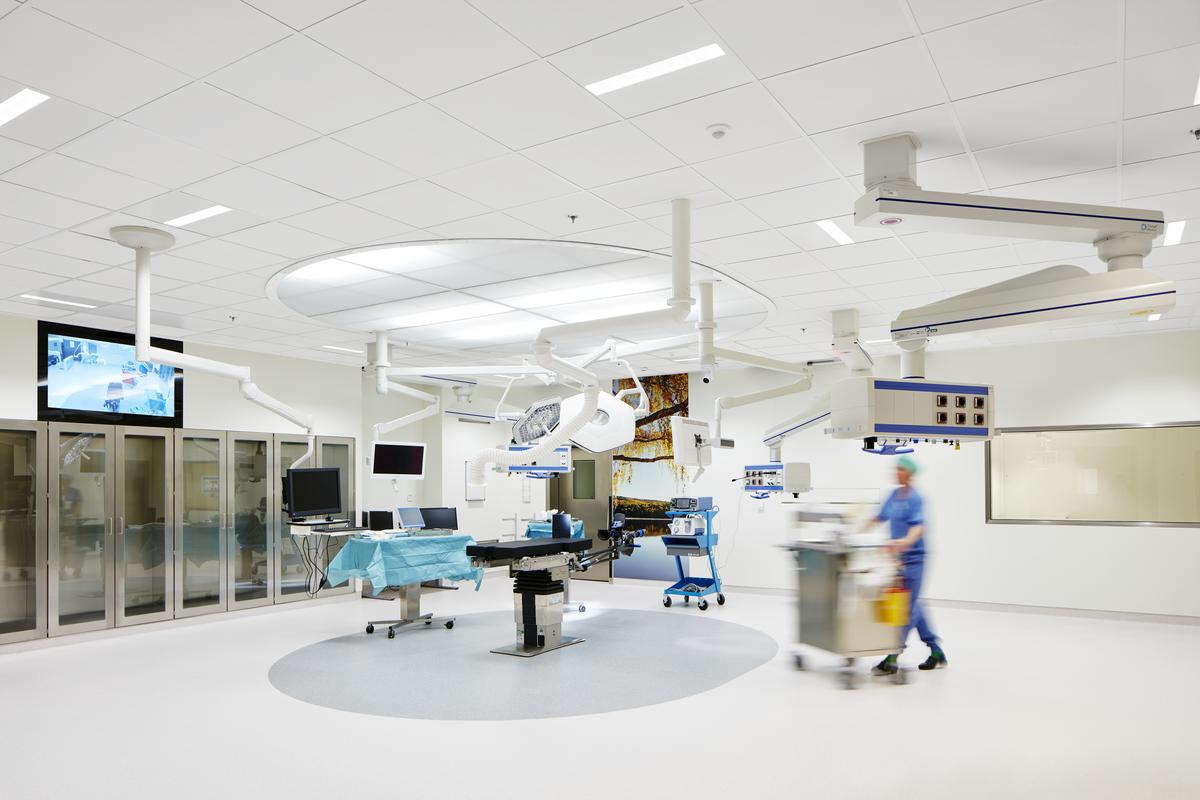
Operating Theatres and Procedure Rooms
Surgical teams depend on clear verbal communication. Background noise in an OT can mask warnings and verbal cues from monitoring equipment. Acoustic design here targets speech intelligibility first, within the most demanding infection control requirements in the hospital.
Related links Ecophon Hygiene Clinic™ E | Browse healthcare acoustic solutions | Contact Ecophon India | Download product brochures
Frequently Asked Questions
Can standard commercial acoustic ceiling panels be used in hospitals?
Standard commercial ceiling panels are generally not suitable for clinical hospital areas. They lack the hygiene performance needed for spaces requiring regular disinfection. Ecophon Hygiene Clinic™ E is specifically designed to resist moisture, mould, and bacteria while delivering Class A sound absorption.
What noise level should hospital patient wards target at night?
The World Health Organisation recommends average noise levels in hospital wards not exceeding 30 dBA at night, with momentary peaks staying below 40 dBA. Most Indian hospitals currently exceed these figures, which is why acoustic ceiling panel specification is a recognised priority in healthcare building design.
How do acoustic ceiling panels help in hospital ICUs specifically?
In an ICU, overlapping alarm sounds in a reverberant space become difficult to distinguish. Ecophon Hygiene Clinic™ E reduces the ambient noise floor, which makes it easier for nursing staff to identify which patient and which device is alerting. This is a direct patient safety benefit.