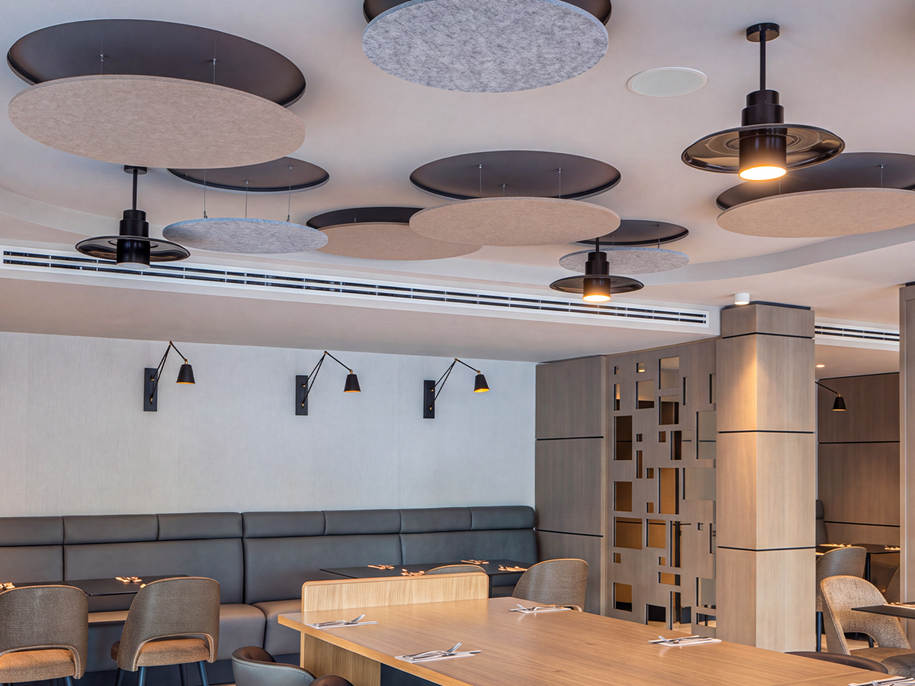
New Ceiling Design Trends Every Architect Should Know
Ceiling design has moved a long way from the uniform white tile grid that defined commercial interiors for decades. As architects push for more expressive, characterful interiors, and as acoustic performance becomes a non-negotiable requirement rather than an afterthought, the ceiling has become one of the more actively evolving surfaces in modern building design.
 Link copied



The Move Towards Seamless Ceilings
One of the clearest shifts in new ceiling design is the move away from visible grid lines altogether. Where a flat suspended tile ceiling once signalled a finished, professional interior, many current projects now favour a continuous, joint-free surface that reads more like a sculpted architectural element than a service ceiling.
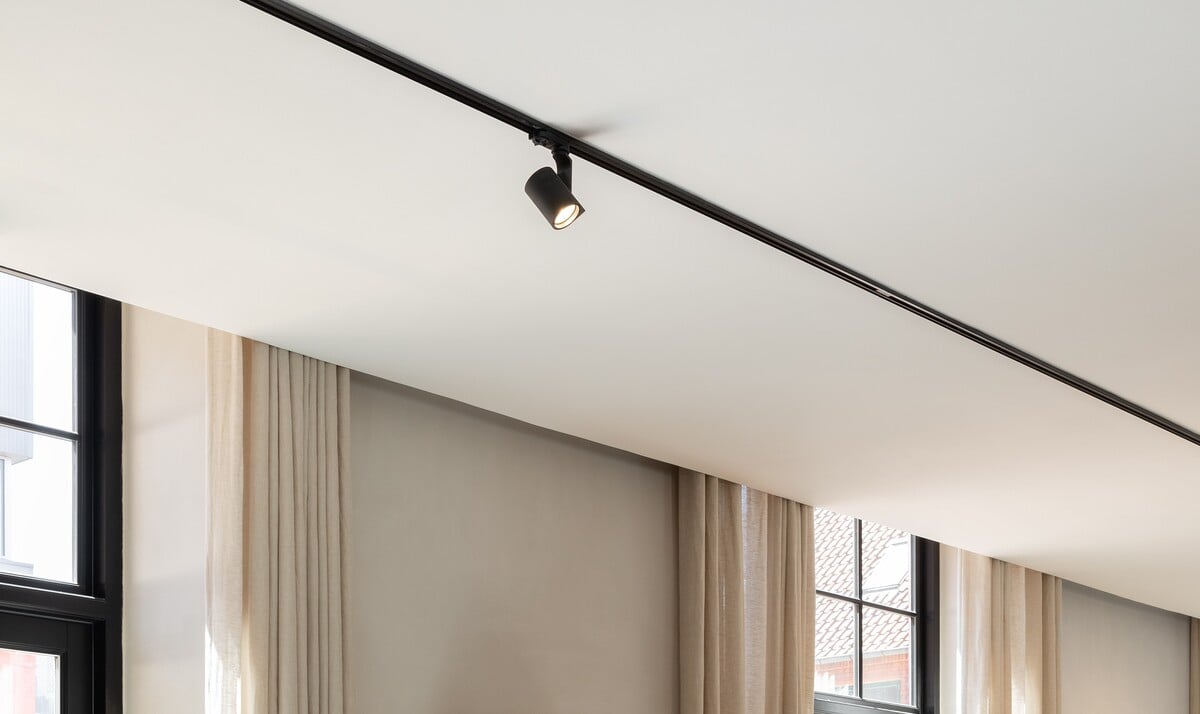
Ecophon Fade ONE Smooth reflects this trend directly. As a spray-applied acoustic plaster with an ultra-smooth finish, it allows a ceiling to disappear visually into a single continuous surface while still delivering genuine acoustic absorption, a combination that a traditional tiled grid cannot offer.
Sculptural and Free-Form Ceilings
At the other end of the design spectrum, free-hanging acoustic elements are being used to create genuinely sculptural ceilings. The Techmania Science Center in the Czech Republic is a striking example, where Ecophon Solo panels were arranged into a sculptural installation inside a former factory building, treating the ceiling as an architectural feature rather than a flat, functional surface.

Colour Returning to the Ceiling Plane
For much of the last two decades, white was the default ceiling colour across almost every commercial interior. That is changing. Dark and coloured ceiling finishes are increasingly used to add depth to a room, reduce glare from artificial lighting, or draw attention to architectural features such as exposed structure or feature lighting. Ecophon's colour and surface range spans this shift across multiple product families, so the same design language can be applied whether the ceiling is a flat grid, a seamless plaster finish or a set of free-hanging panels.
Wall and Ceiling Treated as One Continuous Surface
New ceiling design increasingly treats the ceiling and adjoining walls as a single acoustic and visual system, rather than two separately specified surfaces. Ecophon Akusto wall panels are frequently specified alongside a ceiling treatment for exactly this reason, extending both the acoustic performance and the material language of the ceiling down onto the walls, particularly where a room has hard, parallel surfaces that a ceiling alone cannot fully address.
What This Means for Specification Going Forward
- Seamless acoustic plaster is increasingly specified where a joint-free, architectural finish is the priority
- Free-hanging sculptural elements are used to make the ceiling itself a design statement
- Darker and coloured ceilings are being used deliberately, not just accepted as a design compromise
- Ceiling and wall acoustic treatment are increasingly specified together as one coordinated system
How Indian Commercial Projects Are Adopting These Trends
These global shifts in ceiling design are increasingly visible in Indian commercial and institutional projects, particularly in metro cities where architects are competing to deliver distinctive interiors for corporate clients, hospitality brands and premium retail tenants. Seamless acoustic plaster and sculptural free-hanging installations, once seen mainly in international flagship projects, are now being specified more regularly in Indian office fit-outs and hospitality venues.
This shift is partly driven by client expectations shaped by international travel and exposure to global design trends, and partly by architects themselves pushing back against the sameness of standard grid ceilings that dominated an earlier generation of commercial interiors. As more Indian projects successfully specify and install these newer ceiling types, the perceived risk of moving away from a conventional flat grid continues to fall, making these approaches increasingly mainstream rather than experimental.
None of these trends make the traditional flat suspended ceiling obsolete, and for a great many rooms it remains the correct, cost-effective choice. What has changed is the range of genuinely viable alternatives available to architects who want the ceiling to do more than simply disappear into the background. Staying aware of these newer approaches, and understanding which rooms in a given project might actually benefit from them, is increasingly part of what a considered, contemporary ceiling brief looks like.
Related Reading on Ecophon.com
- Ecophon Fade ONE Smooth acoustic plaster
- A place to explore the possibilities of science (Techmania Science Center)
- Ecophon colours and surfaces
- Ecophon Akusto wall panel range
Frequently Asked Questions
Is seamless acoustic plaster suitable for large commercial ceilings, or only small feature areas?
It can be used across large continuous ceiling areas as well as smaller feature zones. The spray application method allows it to cover extensive areas without the visible joints a tiled system would introduce.
Do darker ceiling colours affect a room's acoustic performance?
Colour and acoustic absorption are generally independent properties of a well-engineered acoustic product, so a dark or coloured finish can typically be specified without compromising the panel's absorption rating, provided the correct surface option is chosen.
How do free-hanging sculptural ceilings integrate with lighting and building services?
Because free-hanging systems sit below the structural ceiling rather than replacing it, lighting and services can generally remain in their existing positions, with panels arranged around fixed points such as light fittings and sprinkler heads.
How can architects stay updated on new acoustic ceiling products as they launch?
Manufacturer websites, product brochures and industry trade events remain the most reliable sources for new launches. Ecophon periodically introduces new finishes and formats across its product families, and reviewing its inspiration and knowledge section regularly is a practical way to track what has recently become available for specification.
Clients evaluating a new ceiling approach for the first time are generally best served by seeing a small sample area installed before committing to a full-floor rollout, since texture, colour and light response can differ subtly between a swatch and a finished room.