
Vilnius University Medical Science Centre
Vilnius, Lithuania
Science Center Ceiling Design Trends That Balance Acoustics and Aesthetics
Picture this. A visitor steps into a brand-new science center gallery. The architecture is stunning: soaring ceilings, polished stone floors, glass display cases everywhere. But the moment twenty other visitors walk in, the room turns into a noise chamber. Conversations pile on top of each other, guides raise their voices, and the serene experience the architects intended becomes something close to a school cafeteria at lunchtime.
 Link copied



This is not a rare problem. It is built into how modern science centers are designed.
Research published in MDPI's Buildings journal (2025) found that contemporary museum architecture frequently prioritises visual aesthetics, including large volumes, open-plan layouts, and highly reflective finishes, and this directly produces acoustic challenges including excessive reverberation, poor speech intelligibility, elevated background noise, and reduced visitor privacy. The same design pressures apply directly to science centers, which share the same soaring volumes and reflective finishes.
The ceiling is at the centre of the solution. And in 2026, architects and acoustic designers are treating it as both a functional tool and a design opportunity.
Let's break it down.
Science center galleries share a cluster of features that make sound control hard. High ceilings create large air volumes. Hard floors, glass display cases, stone walls, and painted surfaces all reflect sound rather than absorbing it. Open-plan layouts allow noise to travel freely between exhibition zones.
The numbers tell the story clearly. A 2025 study by the Institute of Noise Control Engineering measured room impulse responses across 25 exhibition spaces in five museums, including the Museum of Fine Arts in Boston. Reverberation times averaged between 1.3 and 2.9 seconds and peaked at 3.5 seconds at lower frequencies. Speech Transmission Index (STI) values between 0.24 and 0.51 indicated poor to fair speech intelligibility throughout.
Here is why those numbers matter. A guided tour becomes nearly impossible to follow at STI values below 0.45. A visitor with even mild hearing loss can't track conversation at all. And in a room where reverberation time exceeds 2.5 seconds, every spoken word arrives at the listener's ear smeared with echoes from the previous sentence.
Successful acoustic treatment in exhibition halls can bring reverberation time down from 3.5 seconds to around 1.2 seconds and cut background noise by 15 to 20 decibels, according to acoustic assessments cited by multiple industry practitioners.
The ceiling is the most impactful surface to treat. Research from the Acoustical Society of America (2025) confirmed that ceiling treatments deliver the greatest gains in STI and clarity among all surface types, boosting speech intelligibility by as much as 0.16 STI points when moving from a fully reflective surface to an absorptive treatment.
Acoustic treatment in science centers carries a constraint that most other building types do not: the treatment itself cannot compete with the exhibits for visual attention.
A gallery that installs acoustic foam panels on its walls to reduce echo has solved one problem and created another. Visitors are there to see the exhibits, not the foam. The ceiling, on the other hand, is above the sight lines of most display cases and exhibits. It is the one large surface in the room where acoustic treatment can do real work without interfering with the curatorial intent.
Open-plan exhibit areas offer lots of empty space for sound waves to travel across uninterrupted. The challenge is to find ceiling solutions that provide strong acoustic control without pulling focus away from the displays.
This is exactly where modern suspended ceiling design has moved. The most compelling science center ceiling trends of 2024 and 2025 treat acoustic performance and architectural expression as the same problem, not two competing ones.
The biggest shift in science center ceiling design is the move away from wall-to-wall flat ceiling systems toward free-hanging acoustic islands, clouds, and panels hung at varying heights above exhibition spaces.
Free-hanging acoustic panels, sometimes called ceiling clouds, provide an ideal alternative for spaces where a wall-to-wall solution is either not practical or architecturally undesirable. Because they hang freely, both faces of each panel absorb sound. This gives them a higher effective absorption rating per square metre of ceiling area compared with flat, surface-mounted tiles.
These systems also work beautifully in heritage buildings that now house science centers and exhibition spaces. Wire suspension allows installation with a minimal structural footprint, and the panels can be demounted and repositioned as gallery layouts change.
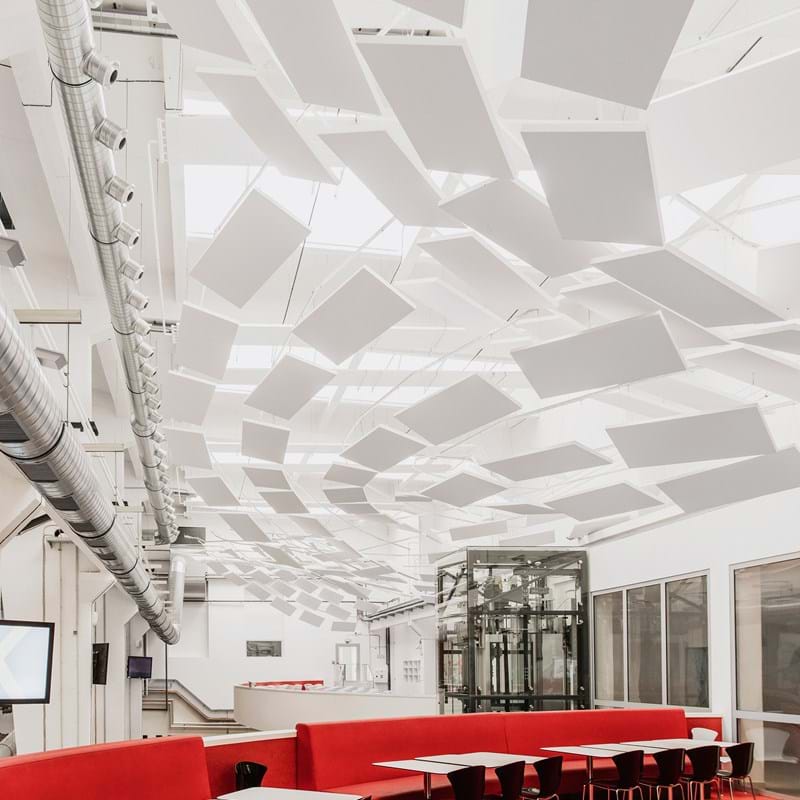
Panels can be hung at varying heights, layered for greater absorption, or arranged in geometric clusters that function as architectural features in their own right. In a science center with a soaring atrium, a cluster of acoustic clouds at mid-height breaks up the vertical sound path while reading as a deliberate design element rather than an acoustic afterthought.
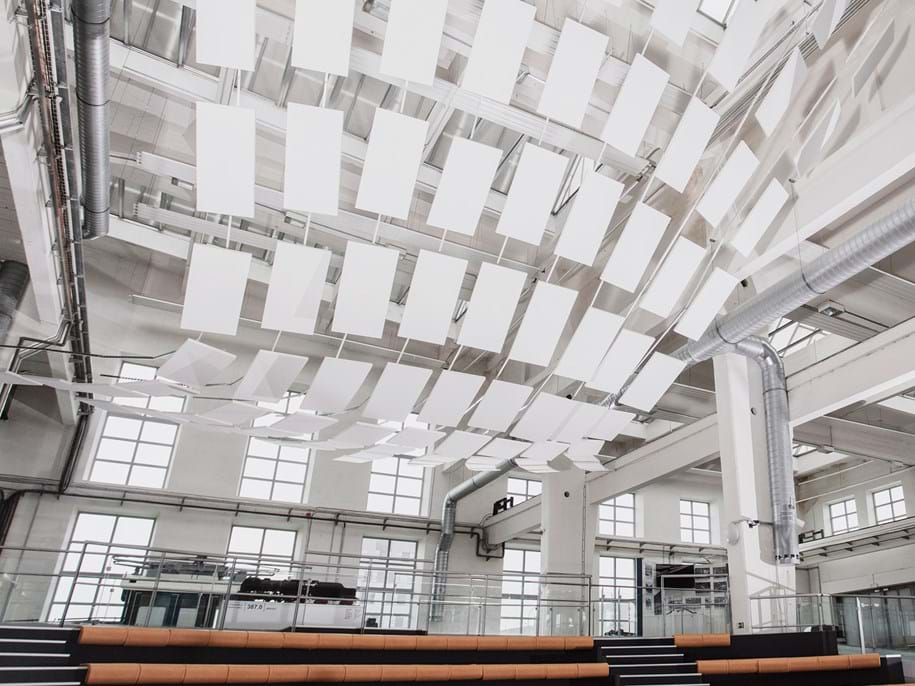
Ecophon, whose acoustic ceiling and wall solutions are available in India has built its free-hanging Solo range around exactly this application. In the Techmania Science Center in Plzeň, Czech Republic, architects used free-hanging Ecophon Solo™ panels to solve exactly this problem in a large, high-ceilinged former factory building, creating a sculptural installation that improved speech clarity while preserving the building's industrial character. The Ecophon Solo Freedom panels can be installed up to five metres from the ceiling structure using adjustable wire systems, or closer to the soffit using bracket fixings. Panels are available in hexagon, ellipse, triangle, and custom shapes, giving designers real latitude to create overhead compositions that complement exhibition themes.
Vertical acoustic baffles, hung in rows from the ceiling, have grown in popularity across science centers and cultural institutions because they solve a specific problem that flat panels cannot: they intercept sound travelling horizontally between visitor groups.
In an open-plan gallery, conversations from one tour group travel across the room and mix with conversations from another. Horizontal baffles create invisible acoustic zones, reducing what acoustic engineers call the distraction distance, the radius within which you can clearly hear someone else's conversation.
Baffles also introduce a strong architectural line to otherwise plain ceilings. They can run parallel, in a wave configuration, in diagonal arrays, or in crossing patterns. Depending on the material and colour chosen, they can reference the palette of a specific exhibition, add industrial texture to a contemporary science center, or sit discreetly in a heritage building.
The suspended ceiling market is responding. Market research published in 2025 projects the global suspended ceiling system market to grow from USD 6.8 billion in 2020 to USD 12.4 billion by 2035, with commercial and cultural spaces among the leading application categories.
The Ecophon Solo™ Baffle range, available in multiple sizes and an extensive colour palette, is designed for precisely this application. The panels can form distinct lines, rolling waves, or zig-zag patterns overhead, and the system's Class A absorption performance means they absorb more than 85% of the sound energy that strikes them.
Science centers that serve as civic and cultural anchors are increasingly specifying ceilings that reference natural materials or combine contrasting textures. Wood, stone-effect panels, textured acoustic plaster, and fabric-wrapped elements all appear in current ceiling design.
Here is why this matters acoustically. Porous and textured materials absorb sound more broadly across the frequency range than smooth, hard surfaces. A ceiling that combines acoustic plaster in some zones with hanging islands in others treats different frequency bands differently, producing a more natural and balanced acoustic result.
Biophilic ceiling design, incorporating organic shapes and natural material references, is among the fastest-growing trends in the global suspended ceiling market. Architects are responding to evidence that connection with natural forms reduces visitor stress and extends dwell time.
For science centers, longer dwell time is a direct measure of engagement. A quieter, more comfortable acoustic environment supports this. Visitors who can hear clearly, move between zones without noise fatigue, and experience a calm overhead environment stay longer and engage more deeply with exhibits.
Modern science center design does not treat the building as a single acoustic environment. Exhibition halls, lecture spaces, reception areas, interactive children's galleries, cafeterias, and gift shops each have different acoustic requirements. Ceiling solutions now reflect this.
Let's break down how this works in practice:
The goal throughout is consistent comfort, not silence. Science centers work best with a low ambient noise level that supports concentration, not dead air that feels institutional.
Not all ceiling solutions perform equally in science center environments. Here is a checklist for architects and project teams:
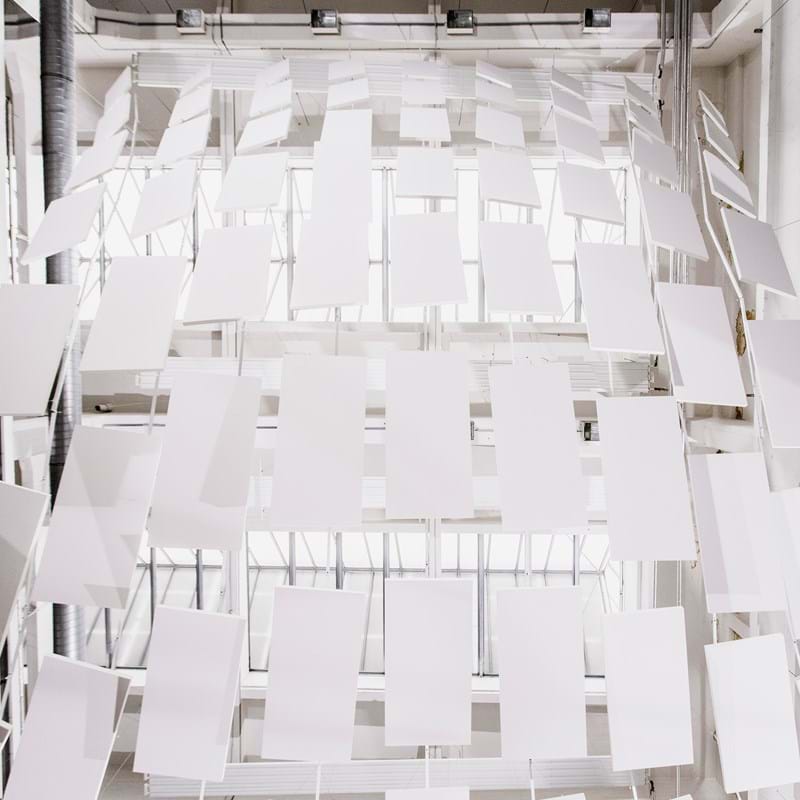
Ecophon's product range for free-hanging and suspended ceiling applications covers all of these criteria. The Akutex FT surface on Solo panels is a breathable, paintable finish that holds colour well and can be cleaned in place.
Q1: What is the recommended reverberation time for science center galleries?
For general exhibition spaces, acoustic designers typically target a reverberation time between 0.8 and 1.5 seconds. This keeps the environment calm and supports speech clarity during guided tours, without creating the artificial deadness of a recording studio. Larger atrium spaces may need slightly longer times to feel natural.
Q2: Can acoustic ceiling treatment be added to an existing science center without closing it?
In most cases, yes. Free-hanging systems like ceiling islands and baffles are installed from above using wire suspension and anchor points, with minimal disruption to the gallery below. Work is typically staged outside visitor hours. Full wall-to-wall ceiling replacement takes longer but can also be phased.
Q3: How do suspended ceiling solutions perform in heritage buildings that house science centers?
Free-hanging systems are a good fit for heritage environments because they require minimal structural fixing. Wire hangers anchor to existing ceiling structure through small grommets, leaving the original ceiling intact. This satisfies most heritage authority requirements while delivering strong acoustic improvement.
Q4: Do acoustic ceiling panels interfere with science center lighting rigs and HVAC systems?
Acoustic baffles and islands can be planned around lighting tracks, sprinkler heads, and ventilation grilles. Good coordination between the acoustic designer, lighting designer, and mechanical engineer at the drawing stage eliminates conflicts before installation. Most free-hanging systems allow panels to be removed and repositioned if services need to be accessed later.
Q5: How do I know how much ceiling treatment my science center gallery needs?
An acoustic consultant can measure your existing reverberation time and STI values, then calculate how much absorption (measured in sabins) is needed to meet your target performance. As a starting point, treating 30–50% of the overhead area with absorptive material in a hard-surfaced gallery typically halves reverberation time. Ceiling treatment consistently delivers the greatest per-square-metre improvement of any surface in a science center space.
