
What Makes Suspended Ceilings Ideal for Data Center Environments
Data centers are unlike almost any other built environment. They run continuously, 24 hours a day, every day of the year. They generate extreme heat. They are filled with machinery that never stops. And they require human technicians to work inside them regularly, often for extended periods, in conditions that quietly accumulate risk.
 Link copied



The ceiling in a data center is not a decorative afterthought. It is a working component of the facility — one that contributes directly to airflow management, thermal containment, fire safety, acoustic conditions, and maintenance access. Get the ceiling wrong and every other system in the building has to work harder to compensate.
This is why suspended ceilings have become the default specification for data center environments worldwide. Let's break down exactly what they do and why they are the right choice for the facilities being built across India right now.
The Data Center Boom That Makes This Urgent
India's data center sector is one of the fastest-growing in the world. The market was valued at USD 6.48 billion in 2024 and is expected to reach USD 10.70 billion by 2030, growing at a CAGR of 8.72%, according to Arizton's market research. As of 2025, approximately 121 operational colocation data centers were active in India, with hundreds of megawatts of additional capacity under active construction and further capacity in the planning stages for the 2024–2028 period, according to Astute Analytica.
Hyperscale operators, cloud providers, and AI workload facilities are all expanding in Mumbai, Chennai, Bengaluru, Hyderabad, and second-tier cities. Every one of these facilities needs a ceiling system specified for the unique demands of the environment.
The decisions made at the design stage — including ceiling specification — directly affect operational costs, energy consumption, staff safety, and long-term facility performance. A suspended ceiling designed for data center use addresses all of these simultaneously.
What a Suspended Ceiling Actually Does in a Data Center

In most commercial buildings, a suspended ceiling is primarily acoustic and aesthetic. In a data center, it is a functional layer of the building's thermal management system. Here is a breakdown by function.
Airflow Containment and the Plenum
The space between the suspended ceiling and the structural soffit above forms what engineers call the return air plenum. In hot aisle containment (HAC) systems — the standard approach in modern data centers — cool air floods the room, passes through the server racks, picks up heat, and the hot exhaust air rises into the ceiling plenum, from where it returns to the cooling units.
This only works if the ceiling is airtight enough to maintain the separation between conditioned room air and hot return air. Leaks in the ceiling plane allow cool supply air to bypass the IT equipment and enter the plenum directly, consuming more energy for no gain in cooling the servers.
Industry testing data published by 7x24 Exchange International found that typical non-gasketed suspended ceilings may have bypass leakage values ranging from 0.6 to 2.0%. Well-specified, factory-gasketed ceiling tile systems combined with a properly engineered structural grid can bring ceiling bypass leakage below 0.6%, matching the containment performance of raised floor systems and delivering measurable energy savings.
The ceiling and grid system chosen must therefore be treated with the same engineering discipline applied to the raised floor and rack containment systems.
Acoustic Control for Staff
Data center technicians work in some of the noisiest indoor environments of any profession. Server room noise levels average 92 dB(A) around server areas and can reach 96 dB(A) within server racks — 7 to 11 dB above the 85 dB(A) action level that triggers mandatory hearing conservation program requirements.
A suspended ceiling with high acoustic absorption values reduces the reverberation and reflected noise that build up in large machine rooms with hard surfaces. Less reverberant noise means technicians communicate more accurately, respond to alarms faster, and sustain concentration during maintenance tasks.
ASHRAE TC 9.9, the technical committee for Mission Critical Facilities and Data Centers, addresses acoustic design as part of its data center guidelines, with the general industry target for IT working environments set at below 65 dB(A) to support staff concentration and monitoring accuracy.
Fire Safety
Data centers are classified as high-risk environments for fire because of the density and value of the equipment they contain. Ceiling panels specified for data centers must carry high fire-resistance ratings — Class A2-s1,d0 or the local equivalent under BIS standards and India's National Building Code — and must not contribute to flame spread or produce toxic gases in a fire event.
Maintenance Access
A suspended ceiling on a demountable grid allows any tile to be lifted out for access to the plenum above, and replaced without tools or damage to adjacent tiles. This is an operational requirement for a facility that cannot afford extended planned downtime for maintenance.
Debris Containment
A sealed ceiling plane prevents particulate contamination of the white space below. Without a ceiling, particles from cables, ducts, and building services above can fall onto server intakes and accumulate on sensitive equipment.
What Data Center Ceiling Solutions Must Deliver
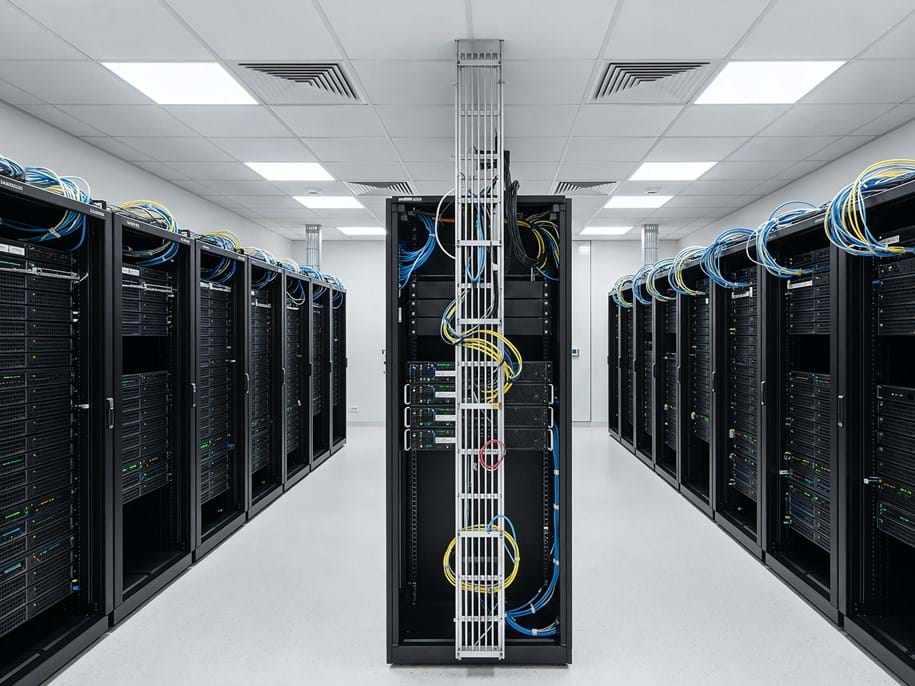
Not every suspended ceiling product is appropriate for a data center. Here is the performance checklist for architects and facilities engineers:
NRC 0.90 or higher (Class A) — reduces reverberation that amplifies server and cooling noise to harmful levels for staff
Cleanability and particle-resistance — surfaces and edges of acoustic ceiling panels must resist particulate accumulation; non-fibrous, sealed surfaces prevent glass wool or mineral fibre from shedding into server room air
Fire safety certification — Class A2-s1,d0 or equivalent, with documentation verifiable under the relevant national standard
Low air leakage — tiles and grid systems specified together as an engineered system tested for leakage rates; gasketed tile perimeters with minimal penetrations are essential for maintaining plenum pressure separation
Structural grid load capacity — data center ceiling grids must support cable trays, containment barriers, light fixtures, and fire suppression hardware without deflection
Humidity and corrosion resistance — data center cooling systems introduce moisture; ceiling grid systems must resist degradation over the facility's operational life
Ecophon, whose acoustic ceiling and wall solutions are available in India through ecophon.com/in, has developed a specific product range for data center environments. Ecophon Hygiene Protec™ Air A is ISO 3 cleanroom classified, with a particle-repellent surface and a rear-side covering that ensures no glass wool is exposed to the room, and is air-leakage tested at ±50 Pa. Ecophon Hygiene Advance™ A is also ISO 3 certified, with a fully encapsulated polymer-film surface that withstands aggressive daily cleaning protocols while maintaining acoustic performance. Ecophon Combison™ Uno A delivers 43 dB sound insulation with a dual-layer composition, high fire-resistance (A2-s1,d0), and a fully demountable, wet-wipable surface.
The Design Decisions That Determine Ceiling Performance
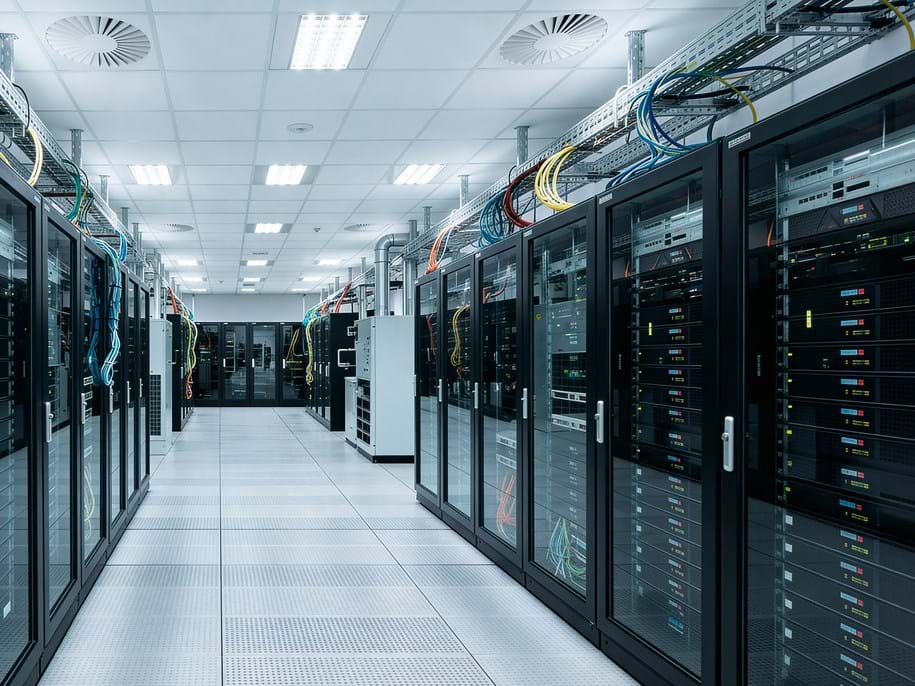
Specifying a data center suspended ceiling is not a catalogue selection exercise. The ceiling system, grid, plenum height, tile edge design, gasket specification, and coordination with mechanical, electrical, and fire suppression systems all interact.
Plenum height — A minimum clearance of 2.6 metres between the raised floor and the suspended ceiling is generally recommended for standard 42U racks, allowing adequate space for overhead cable distribution and maintenance access.
Tile and grid leakage matching — Specifying a low-leakage tile without a matching low-leakage grid defeats the purpose. The grid joints, drop rod penetrations, and tile perimeter gaskets all contribute to total ceiling leakage rate. Specify the tile and grid as an engineered system with documented leakage performance.
Coordination with fire suppression — Ceiling penetrations for sprinkler heads, smoke detectors, and fire suppression components must be sealed to maintain airflow containment performance. Pre-engineered plates and collars sized for penetration components are available from ceiling system manufacturers.
Acoustic treatment in ancillary spaces — The server hall is not the only space needing acoustic consideration. Corridors, control rooms, monitoring stations, and break rooms all benefit from ceiling solutions that reduce cumulative noise exposure of staff across the working day.
Why India's Data Center Build-Out Makes Ceiling Specification Critical Now
India's data center sector is in a construction phase, with a multi-gigawatt development pipeline across the 2024–2028 horizon. Design decisions made today — including ceiling specification — will determine the energy efficiency, staff safety performance, and maintenance costs of these facilities across their operating lives.
A ceiling system that reduces bypass air leakage by even a fraction of a percentage point delivers compounding energy savings across years of continuous operation. A ceiling that absorbs enough noise to keep server room levels below the action threshold removes the need for formal hearing conservation programme administration for every technician shift.
Ecophon's ceiling solutions for data centers, available through ecophon.com/in, carry verified Environmental Product Declarations (EPDs) for lifecycle transparency — a requirement for facilities seeking LEED, BREEAM, or green building certification, which India's hyperscale operators increasingly demand.
FAQs
Q1: What is the recommended acoustic performance for a data center suspended ceiling?
For the server hall itself, a Class A ceiling tile with NRC 0.90 or higher will reduce reverberation and lower accumulated noise levels for technicians. ASHRAE TC 9.9 sets the general industry target for IT working environments at below 65 dB(A) to support staff concentration and monitoring accuracy. Acoustic ceiling treatment is one of the primary tools for meeting this target without requiring hearing protection for routine tasks.
Q2: How does a suspended ceiling contribute to data center cooling efficiency?
The space between the suspended ceiling and the structural soffit forms the return air plenum in hot aisle containment systems. Leaks in the ceiling plane allow cool supply air to bypass servers and enter the plenum directly, wasting cooling energy. Low-leakage, factory-gasketed ceiling tile systems significantly reduce this bypass leakage, as documented by 7x24 Exchange International, translating into direct reductions in fan energy consumption and cooling system load.
Q3: What fire safety rating should data center ceiling tiles carry?
Data center ceiling tiles should carry a high fire-resistance rating — Class A2-s1,d0, or the local equivalent under BIS standards and India's National Building Code — as a minimum. Always verify that both the tiles and the grid system carry the relevant certification, not just one component.
Q4: Can a suspended ceiling be retrofitted into an existing data center?
Yes. Suspended ceilings are installed using a lightweight grid suspended from the structural soffit by drop rods. This system can be installed in an operating facility in phases, working in sections outside operational windows. Tiles are demountable individually, so sections can be replaced or upgraded without taking down the full system.
Q5: How do data center ceiling solutions support green building certification in India?
LEED and BREEAM certification for data center facilities in India assess indoor environmental quality, energy efficiency, and material transparency. Ceiling systems that carry verified EPDs, achieve Class A acoustic absorption, and contribute to airflow containment efficiency directly support certification credits in each of these categories.