
Creating Quiet Library Spaces with Acoustic Ceiling Design
Walk into any modern library and you will notice it has changed. The wall-to-wall shelves and pin-drop silence of a decade ago have given way to collaborative zones, event spaces, children's corners, digital labs, and study pods all under the same roof. That is a lot of activity for a space that is still expected to feel quiet.
 Link copied



The challenge is real. And the ceiling is where most of it gets solved.
Acoustic ceiling design is the single most impactful intervention in a library. Ceilings make up the largest unobstructed surface in most library spaces, and they are where sound reflections are born. Get the ceiling right, and you give every zone in the building from the reading room to the kids' corner a chance to function the way it was intended.
Let's break it down.
Why Libraries Are Acoustically Hard to Get Right
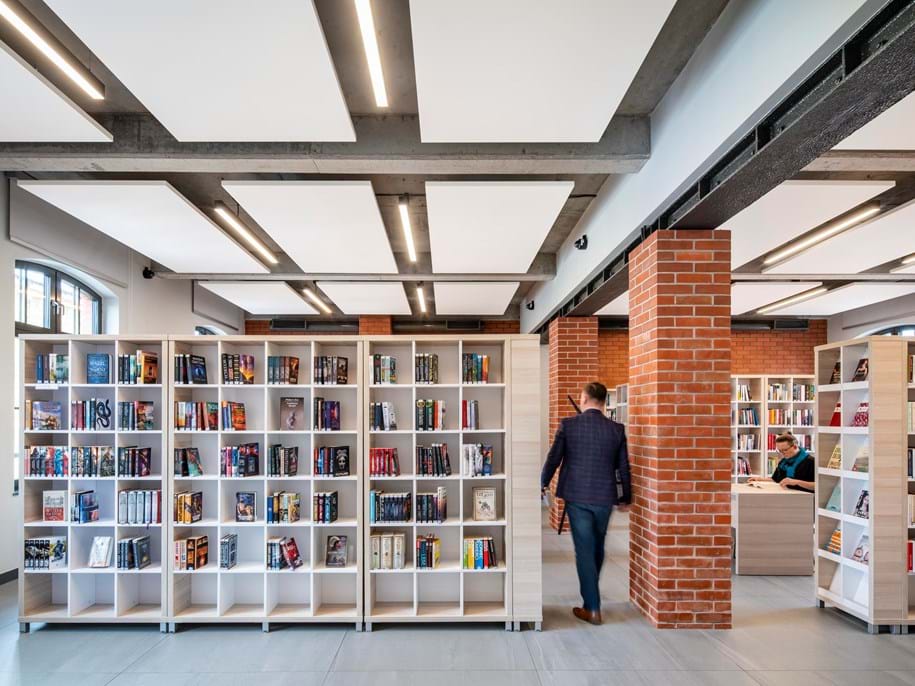
Libraries share a structural problem with museums and sports halls: they are built to look open, and open spaces are bad for sound control.
High ceilings create large air volumes. Hard floors timber, polished concrete, or stone reflect sound upward. Bookshelves do absorb some mid-frequency sound, but they are not designed for that purpose, and they leave large ceiling planes completely untreated. Add in the sounds of footsteps, conversations, rolling carts, printers, and keyboard clicks, and the ambient noise floor in a modern library climbs quickly.
In spaces with high ceilings, like libraries, the effects of reflective surfaces are made worse. Sound waves bounce off walls and floor, travel upward, hit the ceiling, and come back down into the room. This creates echo and reverberation that makes even quiet sounds feel intrusive. The result is that people speak more loudly to be heard, which raises the noise floor further, which causes other people to speak even louder still.
This self-reinforcing cycle is well-documented. There is no such thing as too much absorption in spaces like libraries where the lower the ambient noise, the better. Most libraries have large rooms with high ceilings and an abundance of hard surfaces desks, chairs, shelves, walls, floors so over-treating a library acoustically is rarely the problem.
What the Ceiling Does That No Other Surface Can
Every surface in a library absorbs some sound. Carpets help. Upholstered seating helps. Wall panels help. But the ceiling sits above everything and intercepts sound from every direction simultaneously.
A well-specified acoustic ceiling design with a high Noise Reduction Coefficient (NRC) absorbs sound that would otherwise bounce between the floor and ceiling repeatedly, each reflection adding to the accumulated noise in the room. Reducing that bounce is what controls reverberation time, measured as RT60 (the time it takes for sound to decay by 60 dB after the source stops).
For classrooms and conference rooms, acoustic standards recommend a reverberation time between 0.6 and 1.0 seconds. A quiet library reading room targets a similar range short enough that voices from nearby conversations lose their energy before they carry across the room, but not so short that the space feels unnaturally dead.
The ceiling is also the surface with the greatest structural freedom. Walls carry artwork, shelving, signage, and windows. The floor carries people and furniture. The ceiling is usually open, which is precisely why ceiling solutions — whether modular suspended ceiling tiles or free-hanging panels and baffles — consistently deliver the greatest per-square-metre improvement in room acoustics of any surface in a library.
The Three Zones That Drive Library Acoustic Design
Modern libraries are not single-use spaces. A good acoustic ceiling design accounts for at least three distinct acoustic zones, each with different requirements.
Zone 1: Quiet study and reading areas
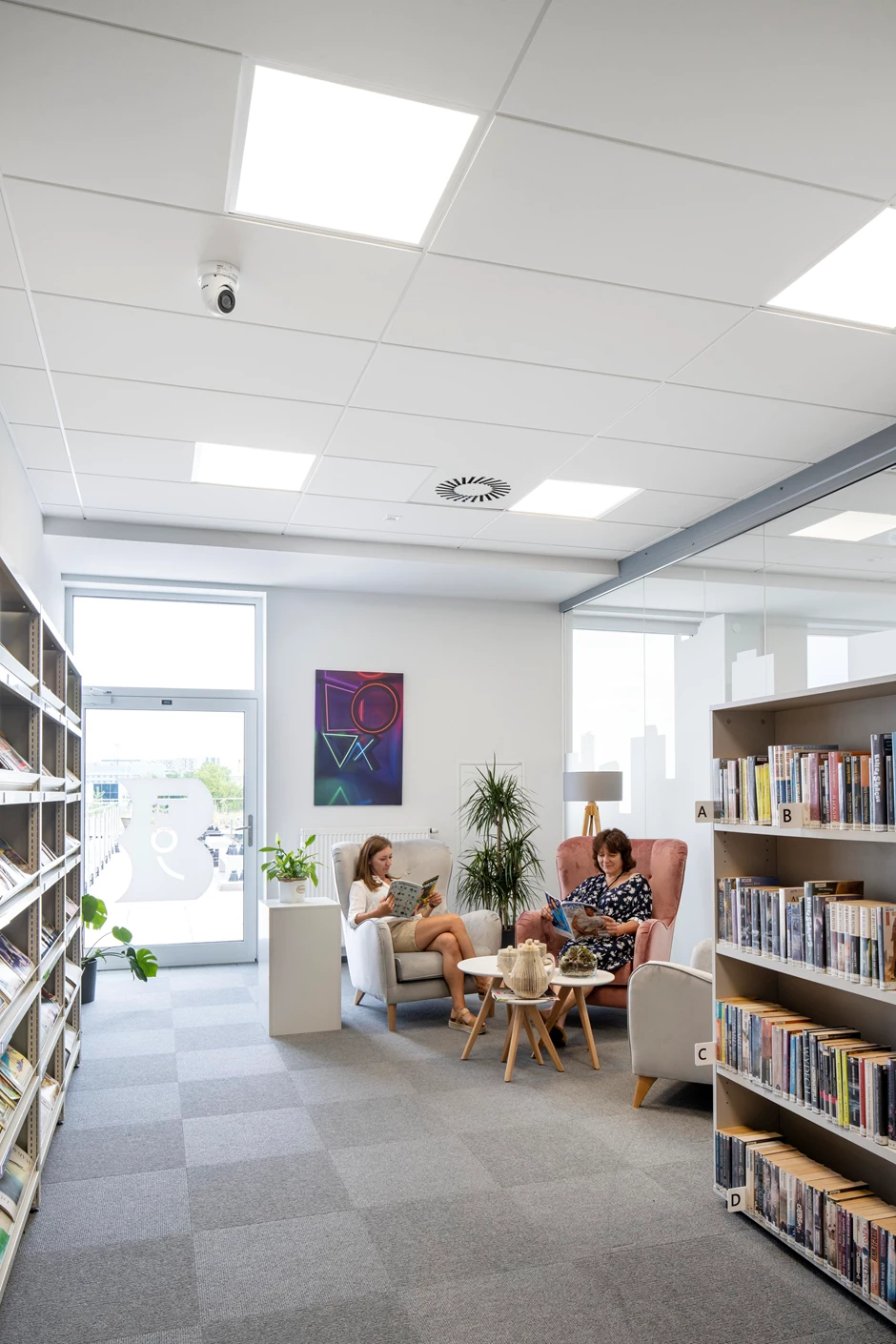
These spaces need low ambient noise, short reverberation times, and materials that absorb speech frequencies efficiently. The goal is to make a whispered conversation inaudible at three metres. Wall-to-wall suspended ceiling systems that cover the full ceiling area perform best here, because full coverage gives sound no reflective path back into the room. Ecophon's modular ceiling range available in India through ecophon.com/in includes the Focus series, a wall-to-wall acoustic ceiling system designed specifically for spaces where visual appeal and sound quality carry equal weight. The Focus A and Focus E variants come with exposed or recessed grid options that give architects design control alongside high acoustic performance.
Zone 2: Collaborative and group study areas.
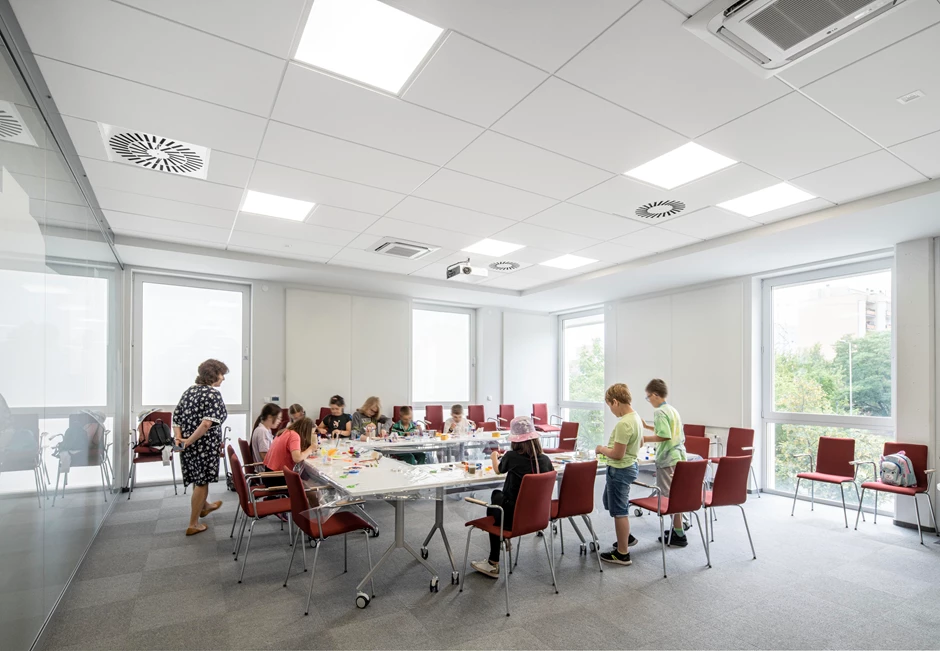
These zones accept more noise than reading rooms but still need control. Without treatment overhead, the ambient noise from six people in a group discussion spills into adjacent quiet zones. Free-hanging acoustic ceiling panels, clouds, or baffles placed above group tables intercept sound at the source and limit how far it travels. They also work with existing ceiling structure, so libraries can treat zones selectively without a full ceiling replacement.
Zone 3: Multi-purpose and event spaces.
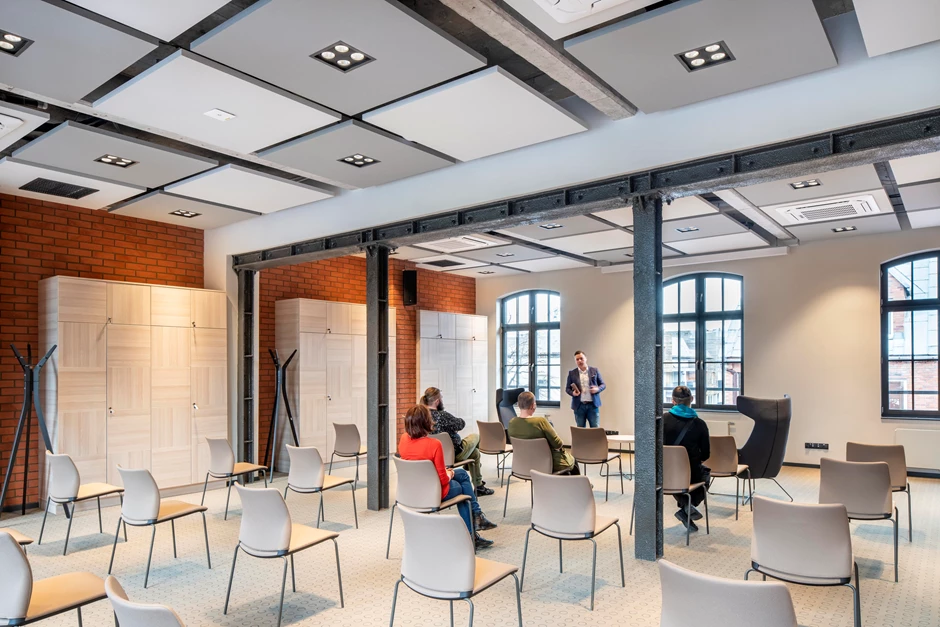
Libraries now host lectures, film screenings, storytelling sessions, and community events. These spaces need ceiling solutions that support speech clarity and control echo in a room that may hold between 20 and 200 people at different times. Reverberation time targets for these rooms sit between 0.6 and 0.8 seconds. Combining modular suspended ceiling tiles with free-hanging baffles or islands gives the room broad coverage and flexible acoustic tuning.
Acoustic Ceiling Design Options for Libraries: What Actually Works
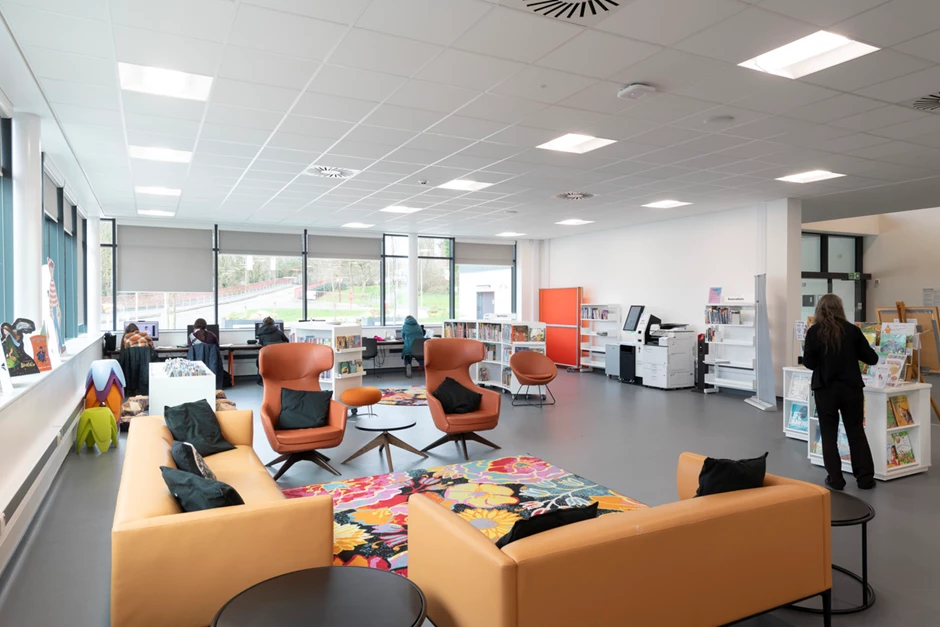
Here is a practical guide to the ceiling solutions most commonly specified in library projects.
Suspended ceiling tiles (modular ceilings). These are the workhorses of library acoustic ceiling design. They cover the full ceiling plane, which gives them the largest possible area for sound absorption. Suspended ceiling systems in the Ecophon Focus range sit in a grid below the structural soffit, leaving a cavity above that also provides thermal and services benefits. Tiles are easily demountable for access to services above. Colour and edge profile options let architects create a clean, minimal ceiling or introduce subtle visual texture.
Free-hanging ceiling panels and islands. Where a full modular ceiling is not possible in a heritage reading room, an atrium, or a space with exposed services free-hanging acoustic panels suspended by wire offer targeted treatment. Because both faces of a hanging panel absorb sound, they are more efficient per square metre than flat-mounted tiles. They can be positioned directly above study tables, group seating, or circulation desks to treat the areas that generate the most noise.
Acoustic ceiling baffles. Vertical baffles hung in parallel rows address horizontal sound travel the path that carries conversation from one table to the next. In a large open-plan reading room, a row of ceiling baffles between zones acts as an invisible acoustic screen. Ecophon's Solo Baffle range can be installed in linear rows or wave patterns, giving designers a ceiling feature that is also a functional tool.
Acoustic plaster. In heritage library buildings with ornate ceilings, sprayed or trowelled acoustic plaster can be applied directly to the existing ceiling surface without changing its visual profile. Reverberation time in a treated room at Lyon's National School of Architecture dropped from 1.9 seconds to 0.6 seconds after Ecophon Fade acoustic plaster was applied to a 143 m² space a result that would have been impossible with a suspended tile system in that building.
Design Principles That Make the Difference
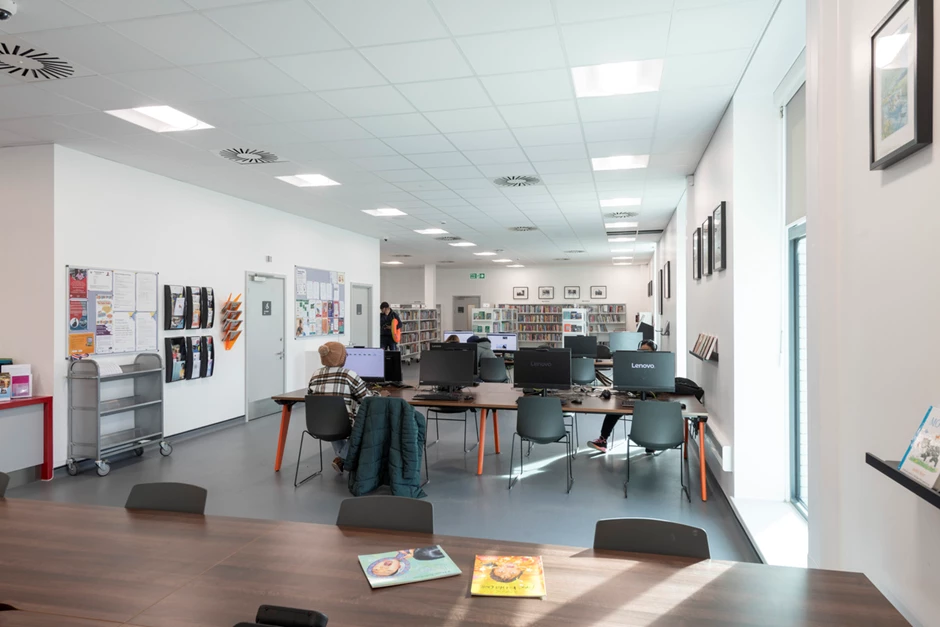
Good acoustic ceiling design in a library is not about covering every square metre with the same product. Here is what separates a well-designed library from one that still has noise complaints after the renovation.
Start with zone mapping before product selection. Identify which areas need the lowest reverberation times, which need moderate control, and which are transition zones. Ceiling solutions are most effective when specified to match the acoustic demand of each space rather than applied uniformly.
Cover as much of the ceiling as possible in quiet zones. Partial ceiling treatment leaves reflective patches that feed noise back into the room. A suspended ceiling that covers 80–100% of the area consistently outperforms a scattered arrangement of clouds or islands at the same total absorption area.
Address low-frequency noise deliberately. Chair scrape, HVAC hum, and footsteps on hard floors all generate low-frequency sound that standard acoustic tiles absorb poorly. Products with enhanced low-frequency performance, such as extra bass panels installed above a standard suspended ceiling grid, make a measurable difference in how calm a space feels, even when NRC values are similar across products.
Integrate lighting and services into the ceiling system. A ceiling plan that coordinates acoustic tiles, light fittings, sprinklers, and ventilation grilles from the start avoids the patchwork appearance that results from retrofitting each system independently. Ecophon's range includes products designed for integrated lighting an important consideration in libraries where reading and study depend on good visual conditions as well as low noise.
Think about maintenance access. Libraries are public buildings. Tiles get replaced and services need access. Specifying an exposed or semi-concealed grid system rather than a fully concealed one makes this easier and keeps long-term maintenance costs manageable.
Real-World Results Libraries Are Achieving
The 2024 Library Design Showcase published by American Libraries Magazine highlighted a consistent finding across award-winning projects: the libraries that delivered the best user experience combined acoustic treatment with flexible zoning and natural light. Acoustic materials and ceiling finishes in the Georgia State University Library Study Commons served double duty reducing noise and providing visual cues that tied different zones together.
At the Nelson Poynter Memorial Library renovation, linear and hexagonal ceiling baffles, together with wood slat ceiling systems, treated distinct zones teleconference rooms, production suites, and open study areas with products chosen for what each zone needed acoustically. The result was a library that functions across the full range of modern academic uses without one zone's activity spilling into another.
These outcomes are achievable in Indian library contexts, from university reading halls to public branch libraries, with the ceiling solutions available through Ecophon India at ecophon.com/in. The product range covers everything from wall-to-wall modular ceilings to custom-shaped free-hanging panels, with colour options that work with both contemporary and traditional library interiors.
FAQs
Q1: What NRC rating should acoustic ceiling tiles have in a library?
For quiet study zones, target NRC ratings of 0.85 or higher. This means the ceiling absorbs at least 85% of the sound energy that strikes it. Modular ceiling systems in the Ecophon Focus range meet or exceed this level across the key speech frequencies (250 Hz to 2,000 Hz), which are the most disruptive in library environments.
Q2: Can acoustic ceiling design be added to an existing library without closing it?
In most cases, yes. Suspended ceiling systems are installed from above using a lightweight grid, which can typically be put in place in sections outside opening hours. Free-hanging panels and baffles require anchor points drilled into the existing ceiling structure — a minimal footprint that does not disrupt collections or shelving below. Phased installation, working zone by zone, keeps the library operational throughout.
Q3: How do I manage the acoustics of both quiet and collaborative zones in the same building?
Zone mapping is the answer. Specify heavier ceiling coverage — modular suspended ceiling tiles — in reading and study rooms. Use free-hanging acoustic panels or baffles selectively in collaborative zones where full ceiling coverage is not needed. Physical separation between zones, combined with appropriate ceiling treatment in each, keeps noise from one zone out of another. Acoustic screens and wall panels reinforce the boundary at floor level.
Q4: Do acoustic ceiling tiles affect the temperature or ventilation in a library?
A suspended ceiling creates a cavity between the tile and the structural soffit that can carry services, including ventilation ducts. Grid-based systems allow ventilation grilles to be integrated directly into the ceiling plane. The cavity also provides some thermal benefit by reducing the volume of conditioned air the building services need to manage. Always coordinate with mechanical engineers during the design stage to ensure airflow is not compromised by tile coverage.
Q5: How long does acoustic ceiling treatment last in a high-traffic public library?
Commercial-grade acoustic ceiling tiles specified for public buildings are designed for 15 to 20 years of normal use with routine maintenance. Most modular ceiling tiles can be demounted and replaced individually without disturbing the rest of the installation. Tile surfaces with factory-applied coatings, such as the Akutex FT finish used in Ecophon products, resist dust accumulation and can be cleaned with standard dry or damp methods, maintaining both acoustic performance and appearance over time.