
How Swimming Pool Ceilings Handle Moisture, Echo and Indoor Comfort
Walk into any indoor swimming pool and the first thing that hits you is noise. Voices bounce off the water, whistles rebound from the walls, and every splash seems to multiply itself. The second thing you notice is the air: thick, warm, and heavy with moisture.
 Link copied



The ceiling above you is doing more work than it appears to be. In a swimming pool environment, the ceiling handles three problems at once: constant high humidity, relentless sound reverberation, and the need to keep the space genuinely comfortable for swimmers, coaches, and lifeguards alike.
Get the ceiling wrong, and you end up with structural damage, mould, and a space so loud that lifeguards cannot distinguish a cry for help from ordinary splashing. Get it right, and the pool becomes a place where people want to stay longer and feel safe.
Here is how well-designed ceiling solutions make that happen.
The Three Problems Every Indoor Pool Ceiling Must Solve
1. Humidity and Moisture Damage
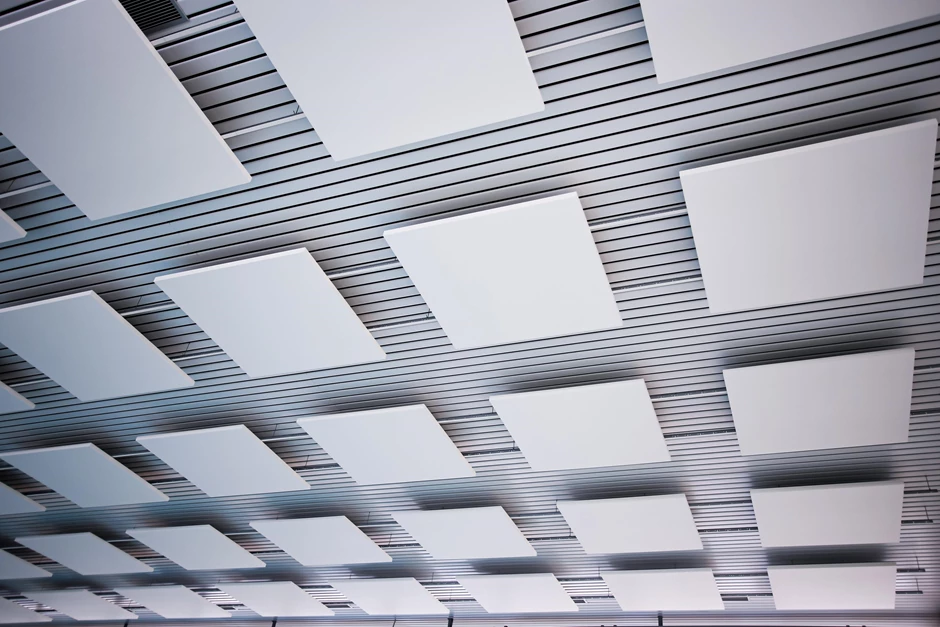
Indoor pool spaces are typically designed to maintain relative humidity around 50 to 60 percent (Rinwang Dehumidification, 2026). In practice, during heavy usage hours, humidity levels can climb to 70 percent or higher.
At those levels, conventional ceiling materials fail fast. Standard drywall and painted surfaces peel, warp, and grow mould. Painted concrete absorbs moisture and eventually develops structural cracks. Even metals corrode when airborne chloramines from pool water settle on unprotected surfaces over time.
Condensation on the ceiling is not just a maintenance headache. It leads to water droplets falling into the pool, which creates a hazard for swimmers and degrades water quality. Over time, persistent moisture penetrates the structural ceiling above, affecting roof assemblies, fasteners, and insulation layers.
Here is why this matters: a ceiling material that cannot handle the humidity will need replacing in just a few years. The cost of that ongoing cycle makes low-quality solutions far more expensive in the long run than a proper acoustic ceiling design installed at the outset.
2. Echo and Reverberation
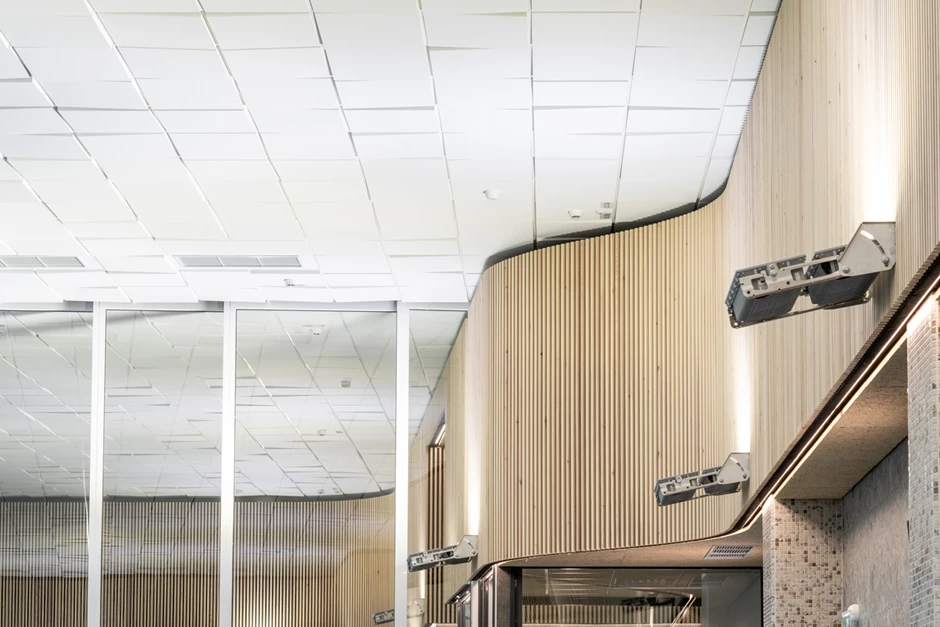
Indoor swimming pools are among the most acoustically difficult spaces to treat. Concrete floors, ceramic tile walls, glass, and the water surface itself all hard, reflective surfaces combine to make pool spaces extremely reverberant.
Reverberation Time (T60) measures how long it takes sound to decay by 60 dB after a source stops. In an untreated indoor pool, T60 times can easily reach 5 to 10 seconds, which creates uncomfortable and even intolerable noise levels (Kinetics Noise Control).
Let's break it down with a real example. A coach shouts a correction to a swimmer. In an untreated pool with a 7-second T60, that instruction continues bouncing around the room long after the coach has stopped speaking, overlapping with the next instruction and making speech completely unclear. Lifeguards face the same challenge: with poor speech intelligibility, distinguishing a call for help from a shout of joy becomes genuinely difficult.
Sound sources in a swimming pool are constant: lifeguard whistles, instructor voices, lane announcements, splashing, mechanical systems, and background music. These all contribute to the overall soundscape. The ceiling is the single largest continuous surface in any pool hall, which makes it the most effective location to place sound-absorbing materials.
3. Indoor Comfort and Air Quality
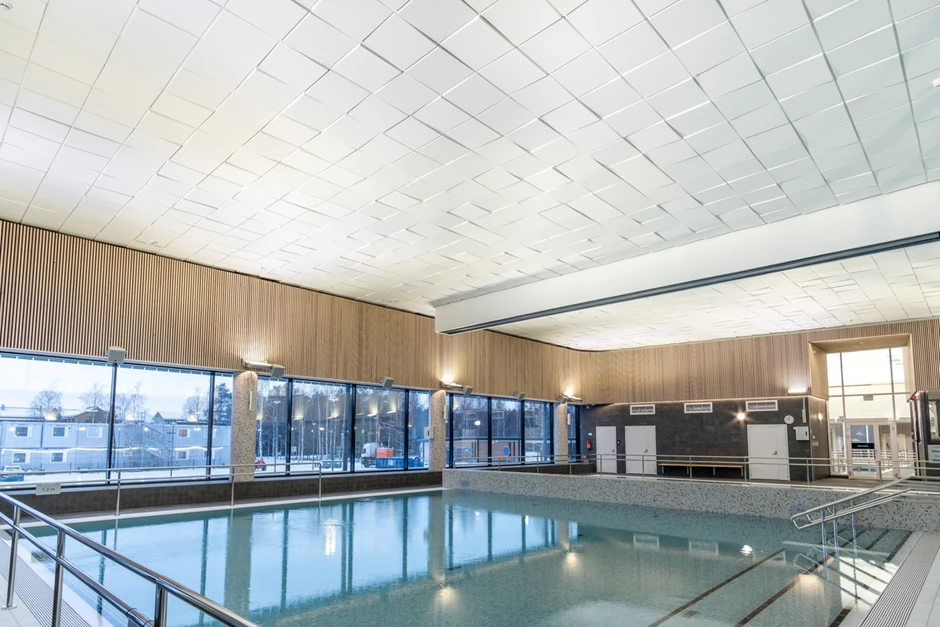
Thermal comfort in an indoor pool is a careful balance. Air temperature is usually kept slightly above water temperature to reduce evaporation (Rinwang Dehumidification, 2026). When this balance is off, condensation forms on cold ceiling surfaces and drips back down.
Beyond temperature, airborne chloramines settle on ceiling materials that have porous surfaces, degrading them over time and reducing indoor air quality. This is why low-emitting materials matter: ceiling panels that do not off-gas chemicals under humid conditions contribute to a cleaner breathing environment for everyone in the pool hall.
What Makes a Ceiling Material Suitable for Swimming Pools
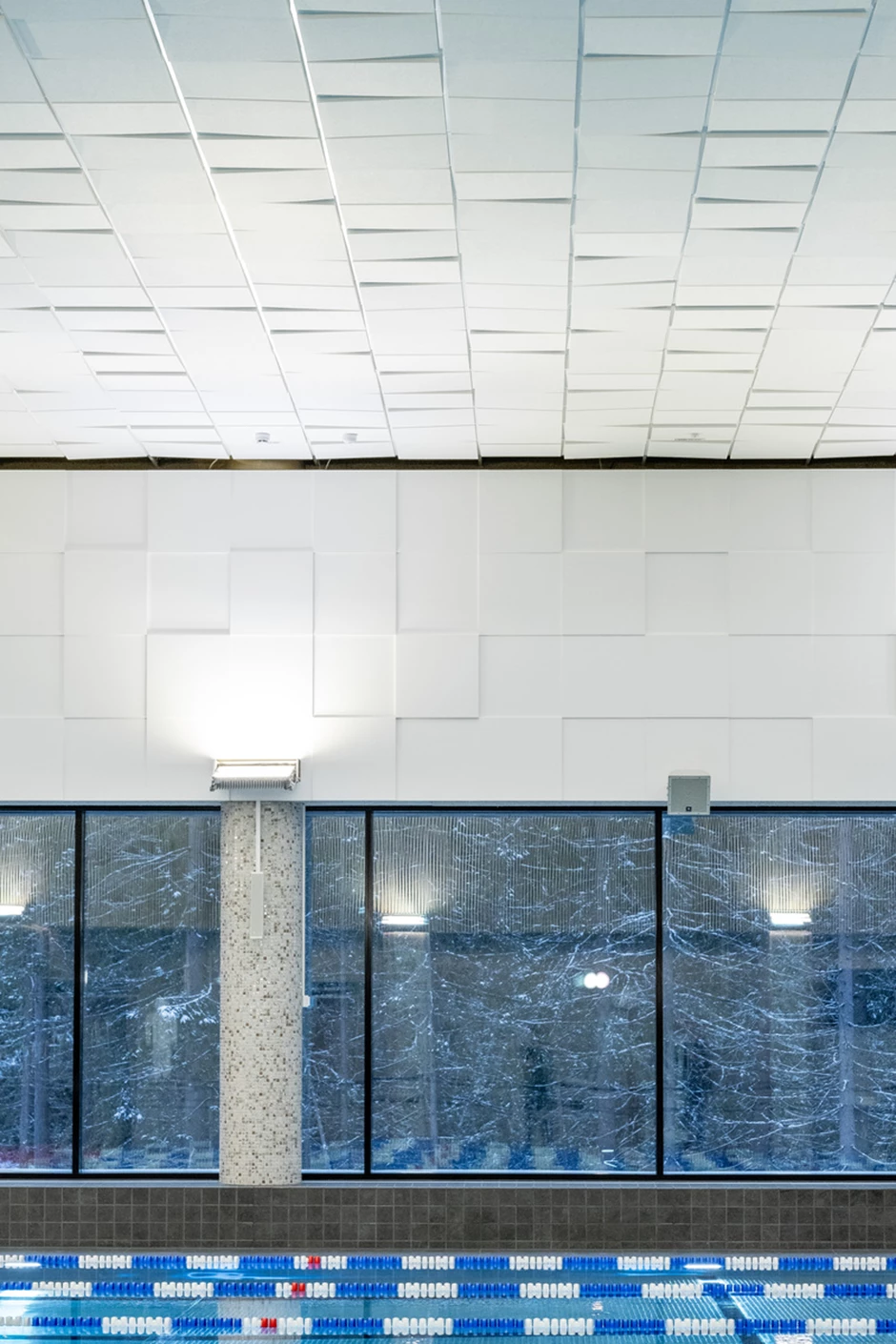
Not every acoustic ceiling material is appropriate for a pool environment. Here is what the specification needs to address.
Moisture resistance. The material must withstand constant high humidity without sagging, warping, or losing its structural form. Materials like glass wool, when properly encapsulated, repel water rather than absorbing it. Ecophon ceiling panels, for instance, use water-repellent glass wool as their core material. Most panels in the range withstand relative humidity of 95% at 30°C without dimensional change (Ecophon Ceiling System Overview).
Corrosion resistance in the grid system. The tiles themselves matter, but so does the suspension system holding them. Grids and accessories used in pool environments need to be corrosion-protected according to ISO 12944 standards: C4 class for pool areas and C3 class for shower areas (Ecophon Pool Areas Guide). Using the wrong grade of grid in a pool environment leads to rust and structural failure of the ceiling system over time.
Mould and bacteria resistance. Mould originates from fungus that reproduces through spores, which settle on damp, organic surfaces. Ceiling materials for pool environments should offer no nutritional value to mould or bacteria. Fully encapsulated panels with smooth, impervious surface coatings are the standard approach.
Sound absorption performance. The panel needs to deliver genuine acoustic absorption, not just aesthetic coverage. Class A sound absorption the highest classification under EN ISO 11654, with NRC values between 0.85 and 1.0 is the target for high-reverberation spaces like pools.
Impact resistance. Pool areas that also serve as sports facilities need ceiling panels that can handle impact from balls and equipment without denting, cracking, or requiring immediate replacement.
Cleanability. Pool environments require regular cleaning with chemical disinfectants. The ceiling surface must withstand this without degrading. This includes tolerance for steam cleaning and high-pressure washing in some facilities.
Ceiling Solutions Designed Specifically for Pool Environments
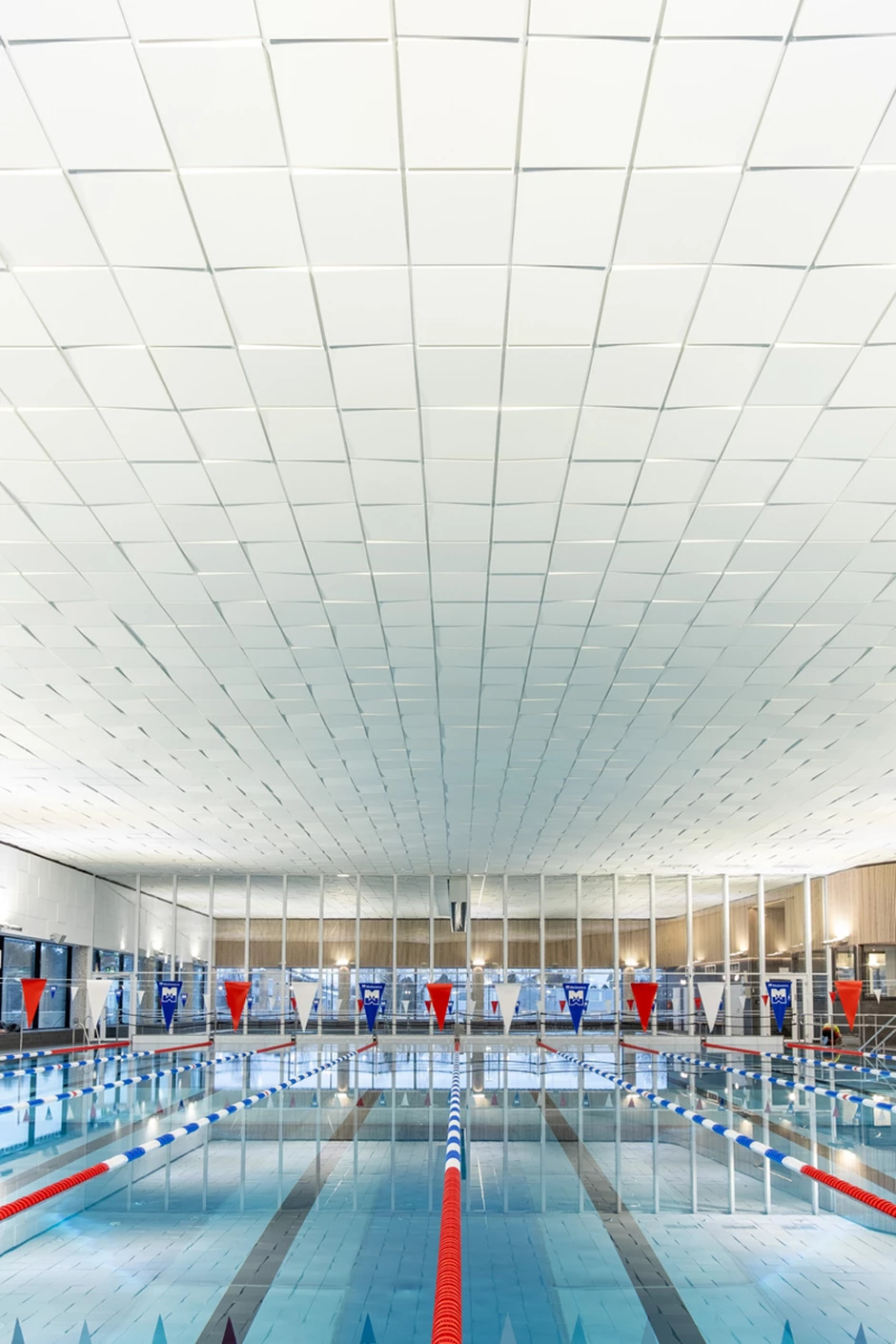
Glass Wool Acoustic Panels
Glass wool is one of the most well-tested materials for humid, chemically active environments. The core absorbs sound effectively while the encapsulation protects the material from moisture and chemical exposure.
Ecophon, part of the Saint-Gobain Group, produces ceiling panels specifically designed for swimming pool applications. Their Hygiene Performance range uses high-density glass wool tiles with Akutex HS coating on the visible surface, paired with glass tissue on the back. The system uses C4-compatible grids for pool areas and C3-compatible grids for shower areas, meeting the ISO 12944 corrosion classification requirements.
The Hygiene Advance range goes further, designed for the most demanding conditions. The tiles are fully encapsulated in a smooth, impervious high-performance film and can withstand daily cleaning and disinfection with strong chemicals, including HPV cleaning protocols. These panels are low-emitting, contributing to better indoor air quality in an environment where air quality already faces pressure from chloramine exposure.
The Hygiene Performance Ds variant features a concealed grid system with easily demountable tiles, making maintenance access practical without requiring the ceiling to be dismantled.
Wall-to-Wall Suspended Ceiling Coverage
For the most effective acoustic control in a pool hall, the ceiling treatment should be wall-to-wall rather than partial. Ecophon's guidance for pool environments specifically recommends wall-to-wall sound-absorbing ceiling coverage as the primary acoustic ceiling design strategy (Ecophon Pool Areas Guide).
Here is why: a partial ceiling treatment leaves large reflective surfaces untreated. Sound from those surfaces continues to bounce and add to the overall reverberation. Wall-to-wall coverage captures the sound before it has the opportunity to accumulate.
Free-Hanging Baffles and Islands
Where a full suspended ceiling is not practical in pools with exposed roof structures or architectural feature ceilings free-hanging baffles offer a direct route to acoustic improvement.
Baffles hang vertically from the structural ceiling and absorb sound on both faces, making them two-sided in terms of absorption area. In humid environments, the hanging hardware must be specified in stainless steel to prevent corrosion at the mounting points.
Acoustic islands hang horizontally. They work well above specific zones such as spectator seating areas, coaching stations, or entry lobbies where the noise problem is concentrated.
The Link Between Ceiling Design and Swimmer Safety
This is the part that often gets missed in design discussions focused on aesthetics and cost.
Pool areas are workplaces. Lifeguards are trained to respond to acoustic cues a call for help sounds different from a shout of excitement, but only when speech clarity is sufficient. In a pool with a T60 of 6 seconds or more, that distinction becomes unreliable.
Reducing reverberation through proper acoustic ceiling design gives lifeguards better conditions to do their job. It allows swimming coaches to give clear instructions across a lane without shouting repeatedly. It reduces the overall stress load on staff who spend full shifts in a high-noise environment.
A 2024 study on pool acoustic management noted that effective ceiling and wall treatments improve communication between coaches and athletes, and between lifeguards and swimmers, producing environments that are both safer and more functional (Integrity Pools, 2024).
Planning Your Pool Ceiling: What to Address at the Design Stage
Next steps if you are specifying or renovating an indoor pool ceiling:
- Confirm the corrosion classification required. ISO 12944 C4 applies to pool halls where chloride exposure is direct. C3 applies to adjacent humid areas like changing rooms and shower zones. Specify the grid system to match, not just the panels.
- Set a target reverberation time. For a competitive swimming facility, target a T60 that supports clear speech without creating dead silence. Work with an acoustic consultant to model the space before specifying coverage area.
- Select panels rated for high humidity. Look for panels tested to maintain their form at 95% relative humidity. Encapsulation and surface coating should be specified, not assumed.
- Plan for maintenance. Tiles need to be demountable for inspection of the plenum and for replacement without full ceiling removal. Specify clip systems that hold tiles secure against air pressure differentials from ventilation systems.
- Consider wall panels alongside the ceiling. In pool halls with high side walls, acoustic ceiling design alone may not bring reverberation down to target. Paired wall panel coverage particularly at mid-height where sound sources are concentrated produces better results than ceiling-only treatment.
FAQs: Swimming Pool Ceiling Design
- What is the main reason indoor swimming pool ceilings deteriorate so quickly?
The combination of high humidity, airborne chloramines, and condensation breaks down most standard ceiling materials within a few years. Moisture causes warping and mould, while chlorine compounds accelerate corrosion on metal grids and surfaces. Selecting materials rated for pool environments from the start prevents this cycle and reduces long-term maintenance costs significantly.
- How much can acoustic ceiling panels actually reduce echo in a pool?
In an untreated indoor pool, reverberation times of 5 to 10 seconds are common. Properly installed, wall-to-wall acoustic ceiling panels with Class A absorption ratings can bring that figure down to a range that supports clear speech. The exact improvement depends on room volume, ceiling height, and what proportion of wall surface is also treated.
- What corrosion standard should I specify for pool ceiling grids?
Use ISO 12944 C4-rated grids for the main pool hall, where chloride exposure is direct and ongoing. For adjacent areas like showers and changing rooms, C3-rated grids are appropriate. Using standard commercial-grade grids in these environments leads to rust and ceiling system failure within a few years of installation.
- Can acoustic ceiling panels be cleaned with the same chemicals used for pool hygiene?
This depends entirely on the product. Panels designed specifically for pool and hygiene environments, such as those in Ecophon's Hygiene range, are tested to withstand steam cleaning, high-pressure washing, and common chemical disinfectants. Standard commercial acoustic panels are not designed for this and will degrade under the same treatment.
- Is a wall-to-wall ceiling necessary, or can baffles achieve the same acoustic result?
For most competitive pool facilities, wall-to-wall ceiling coverage delivers more consistent reverberation reduction than baffles alone. Baffles work well in spaces with exposed roof structures where a full ceiling system is not practical, but they require careful placement and sufficient quantity to match the performance of a full suspended ceiling. A combination of both is often the most effective approach in large-volume natatoriums.