
Industrial Ceiling Solutions for Noise Control in Large Facilities
Step onto the floor of any large manufacturing plant, warehouse, or food processing facility and the noise hits you immediately. Machinery hums, conveyors clatter, forklifts beep, and every hard surface in the building throws the sound right back at you.
 Link copied



That noise is not just uncomfortable. It is a workplace hazard, a productivity drain, and in many facilities, a regulatory compliance issue.
The ceiling is the largest single continuous surface in any industrial building. In most facilities, it does nothing to help. Bare metal decking, exposed concrete soffits, and steel trusses are among the most reflective surfaces possible, turning every sound in the building into a prolonged echo that builds on itself across the entire floor.
The right acoustic ceiling design changes that dynamic entirely. Here is how ceiling solutions work in industrial environments, what the regulations require, and what to look for when specifying treatments for large-scale facilities.
Why Industrial Noise Is More Than a Comfort Problem
Let's start with the scale of the problem.
According to the U.S. Centers for Disease Control (CDC), approximately 22 million workers are exposed to potentially damaging noise at work each year (OSHA, Occupational Safety and Health Administration). The National Institute for Occupational Safety and Health (NIOSH) recommends an 8-hour exposure limit of 85 dBA as a time-weighted average. OSHA's permissible exposure limit (PEL) is set at 90 dBA for an 8-hour workday.
When those thresholds are exceeded, employers must implement a hearing conservation program. Fail to comply after a warning, and OSHA can impose fines of up to $14,000 per violation with additional daily fines until the issue is resolved (Memtech Acoustics, 2026).
But hearing protection and compliance programs only address part of the problem. Here is why noise control at the source and at the ceiling level matters beyond the regulatory numbers.
Communication breaks down. Noisy environments disrupt workplace communication, leading to errors, accidents, and reduced productivity. Workers may struggle to hear warnings or react to alarms, increasing safety risks (MDPI Sustainability, 2025). In a factory where a worker needs to shout across three metres to be understood, safety instructions and emergency signals become unreliable.
Cognitive performance drops. Peer-reviewed research consistently shows that noise exposure leads to reduced cognitive function, increased error rates, and higher mental workload. Workplace noise exceeding 85 dB directly links to reduced task performance and heightened stress levels (BMC Public Health, 2025).
Absenteeism rises. Chronic noise exposure leads to increased absenteeism and reduced workplace efficiency. Insomnia, often linked to noise exposure at work, raises the risk of accidents and errors the following day (PMC/NCBI, 2024).
This means acoustic ceiling design in industrial settings is not a luxury. It is part of a functional workplace safety and health programme.
Why Industrial Buildings Are So Acoustically Difficult
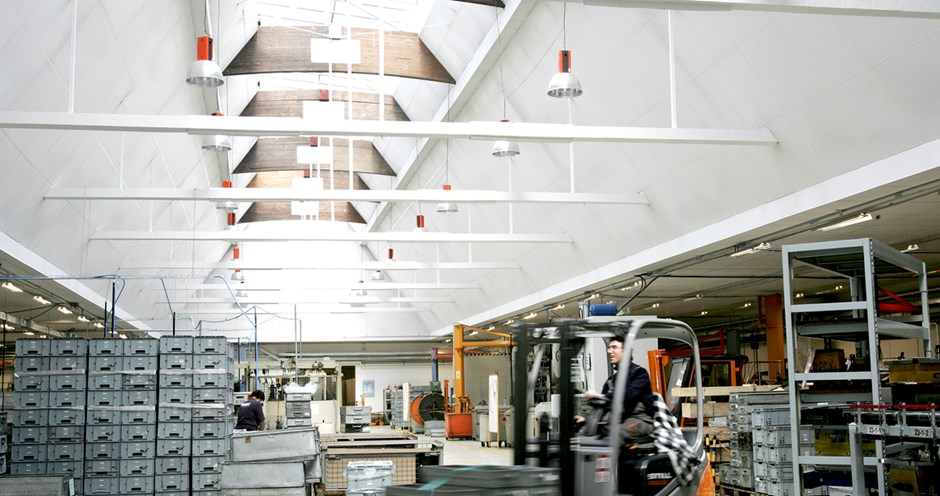
Most industrial facilities share a set of features that make noise control challenging. Let's break it down:
Hard, reflective surfaces everywhere. Concrete floors, metal wall cladding, steel roof decking, glass partitions these surfaces absorb almost no sound. When a sound wave hits them, nearly all of the energy bounces back into the space.
High ceilings and large open volumes. Large uninterrupted floor plans with high ceilings give sound room to travel far before it hits a surface. The result is prolonged reverberation time — the length of time sound takes to decay after the source stops. In a large industrial building with a bare ceiling, reverberation times of several seconds are common.
Continuous, broadband noise sources. Machinery produces sound across a wide frequency range. High-frequency sounds from metal cutting and woodworking tools are easier to absorb than low-frequency sounds from generators, compressors, and large presses. A good ceiling solution needs to perform across both.
Limited wall space. In active production facilities, walls are often occupied by racking, machinery, conveyors, and equipment. Floor-mounted or wall-mounted acoustic treatments frequently cannot be installed without disrupting operations.
The ceiling, by contrast, sits above all of that. Treating the ceiling does not require moving a single machine.
What Acoustic Ceiling Solutions Work in Industrial Environments

Here is a breakdown of the ceiling treatment options most commonly specified for large industrial facilities, and what each one does well.
Suspended Acoustic Ceiling Panels
A suspended ceiling — a secondary ceiling installed below the structural one — offers wall-to-wall sound absorption in facilities where the roof structure is not exposed. Panel materials built from glass wool or mineral fibre absorb sound energy across a broad frequency range.
Ecophon, part of the Saint-Gobain Group, produces an industrial ceiling range specifically engineered for production environments. Their Industry product family includes ceiling systems with high impact resistance and strong, technical surface layers that make the panels more resistant to wear. These panels are designed for manufacturing spaces where durability matters as much as acoustic performance.
For food processing plants and industrial kitchens, Ecophon's Hygiene Foodtec range provides Class A sound absorption alongside the ability to withstand aggressive chemical cleaning methods and strict hygiene requirements. All panels in this range maintain their acoustic performance even in high-humidity, chemically active environments — a common challenge in food production facilities.
When hygiene is a top consideration, production environments with bare, hard surfaces generate very high noise levels and echo effects that create both safety and health hazards. Ecophon offers acoustic solutions for different kinds of production environments with high hygienic demands (Ecophon, Industrial Environments Guide).
Free-Hanging Baffles
Where a full suspended ceiling is not practical in facilities with exposed trusses, very high roof structures, or active overhead cranes, free-hanging acoustic baffles are the standard solution.
Baffles are vertically suspended panels that hang from the structural ceiling or roof frame. Because they are exposed on both faces, they absorb sound on two sides simultaneously. This makes them highly efficient per panel; one baffle absorbs roughly twice the sound of a wall-mounted panel of the same size.
In manufacturing plants, warehouses, and production units, uncontrolled sound from machines bouncing between floors, ceilings, and walls leads to prolonged reverberation time, making the environment louder than the actual machine output. Installing acoustic ceiling baffles manages sound at the source of reflection, particularly in facilities with high ceilings and limited wall space (Ecotone, 2026).
Baffles are especially useful above active production zones, where noise sources are concentrated. They intercept sound before it has the chance to spread across the wider facility, creating quieter conditions in the zones that matter most.
Acoustic Islands (Horizontal Free-Hanging Panels)
Acoustic islands are flat panels that hang horizontally from the ceiling structure. They work differently from baffles where baffles hang vertically and absorb from both sides, islands present a large horizontal face that captures sound rising from the production floor.
Islands work well above specific work stations, quality control areas, break rooms within production facilities, and control rooms. They can be positioned directly where noise and worker concentration are most in conflict, without requiring treatment of the entire ceiling area.
Ecophon's range includes both baffles and island units suitable for industrial environments. Combined with modular ceiling panels where the roof structure allows, these free-hanging elements give facility managers flexibility to target the noisiest zones first.
Acoustic Plaster
For industrial facilities with curved or irregular ceiling structures where standard panel systems cannot be fitted, acoustic plaster is an alternative. Sprayed or hand-applied directly to the substrate, it creates a continuous sound-absorbing surface without visible joints or grid lines.
This approach suits entrance halls, internal corridors, and the ceiling surfaces of ancillary spaces within large industrial buildings.
Choosing the Right Ceiling Solution: What to Assess First
Next steps for any facility manager or specifier working on an industrial noise control project:
- Measure existing noise levels and reverberation time. Before selecting any ceiling product, get acoustic measurements done. You need to know the existing dBA levels at worker positions, the reverberation time in different zones of the facility, and where the primary noise sources are located. This data directly drives the specification.
- Identify the facility's specific environmental demands. A dry general manufacturing plant has different requirements from a food processing line that uses steam cleaning and chemical disinfectants. Specify panel systems to match moisture resistance, chemical resistance, and cleanability are product-level decisions, not assumptions.
- Map ceiling access and structure constraints. Overhead cranes, fire suppression systems, ventilation ducts, and lighting all affect where panels and baffles can be placed. Plan ceiling treatments around these systems, not after them.
- Set a target reverberation time for each zone. Production floor, control rooms, canteens, and internal corridors all have different acoustic requirements. A production floor tolerates longer reverberation than a control room where speech clarity is essential. Define the target for each zone before specifying coverage.
- Consider a zoned approach. Full wall-to-wall coverage produces the most consistent results, but in large facilities it is sometimes more practical to treat the highest-priority zones first above heavy machinery, above quality control stations, and in areas where worker communication is most safety-critical. A phased approach lets you measure results zone by zone.
- Verify fire performance ratings. All ceiling materials in industrial facilities must comply with fire classification requirements. Ecophon glass wool panels are classified as non-combustible according to EN ISO 1182 an important specification for facilities with fire safety obligations.
The Case for Engineering Controls Over Personal Protective Equipment
A common response to industrial noise is to issue hearing protection earmuffs, earplugs, and similar devices. These protect individual workers from hearing damage when used correctly. They do not fix the underlying problem.
Here is why this matters: personal protective equipment (PPE) only works when it is worn consistently and fitted correctly. In practice, workers remove hearing protection when communicating, during breaks, and in adjacent areas where they feel the noise level is lower. Meanwhile, background noise levels affect stress, concentration, and reaction times even at exposures below the threshold for hearing damage.
Engineering controls changes to the building and its surfaces work passively and continuously, regardless of whether workers remember to put anything on. Acoustic ceiling design falls squarely in this category. Treated ceilings absorb sound energy before it can accumulate, lower the overall ambient noise floor in the facility, and improve speech intelligibility so that workers can hear safety warnings and instructions at normal speaking volumes.
A good acoustic environment can improve task motivation by 66%, according to research by Evans and Johnson at Cornell University (cited in Ecophon Clean Environments resources). Reducing noise below the threshold where it becomes disruptive changes the character of the working environment in a measurable way.
What Ecophon Offers for Industrial Settings
Ecophon (ecophon.com/in) is a specialist acoustic ceiling and wall panel manufacturer, part of the global Saint-Gobain Group. Their industrial product range covers general manufacturing environments, food and beverage production, pharmaceutical manufacturing, medical device production, and clean-room settings.
The core material across the Ecophon range is glass wool, a material tested as non-combustible under EN ISO 1182 and manufactured using approximately 70% recycled glass content. The panels deliver Class A sound absorption the highest classification under EN ISO 11654, with NRC values between 0.85 and 1.0.
For clean and controlled industrial environments, Ecophon's Hygiene range meets ISO 14644-1:2015 classified environment standards and includes products compatible with GMP (Good Manufacturing Practice) requirements in pharmaceutical and food production settings. Their Connect ceiling grid systems are available in corrosion resistance classes to match different chemical exposure levels in the facility.
The free-hanging baffle and island systems from Ecophon are suited for open industrial spaces where a full ceiling grid is not practical, and can be combined with modular ceiling panel systems to treat different zones within the same facility.
FAQs: Industrial Ceiling Solutions and Noise Control
- What is the legal noise exposure limit for workers in industrial facilities?
OSHA sets a permissible exposure limit of 90 dBA as an 8-hour time-weighted average for general industry in the United States. NIOSH recommends a more protective limit of 85 dBA. Under OSHA 29 CFR 1910.95, employers must implement a hearing conservation programme when exposures reach or exceed 85 dBA. Failing to comply after a formal warning can result in fines of up to $14,000 per violation.
- Will ceiling panels alone be enough to bring noise levels into compliance?
Ceiling treatments reduce reverberation and lower the overall ambient noise floor in a facility, but they are one part of a broader noise control strategy. In facilities with very loud machinery, source isolation enclosures, vibration damping, and barriers around equipment — is often needed alongside ceiling treatment to reach target levels. A qualified acoustic consultant can model the expected results before installation.
- How do baffles differ from standard ceiling panels for industrial use?
Standard ceiling panels sit within a grid system below the structural ceiling, providing wall-to-wall coverage. Baffles hang freely from the structure and are exposed on both faces, which makes them effective in tall spaces with exposed trusses or overhead cranes where a grid ceiling cannot be installed. Baffles absorb sound from both sides simultaneously, making them highly efficient per unit of material.
- Can acoustic ceiling panels withstand industrial cleaning in food production facilities?
Yes, but only panels specifically designed for that purpose. Standard acoustic ceiling panels are not rated for steam cleaning, high-pressure washing, or exposure to chemical disinfectants. Panels from ranges like Ecophon's Hygiene Foodtec family are engineered and tested to withstand these cleaning methods while maintaining their acoustic performance and surface integrity over time.
- How do I know how much ceiling coverage my facility needs?
This depends on the volume of the space, existing surface materials, the noise sources present, and your target reverberation time. The starting point is an acoustic measurement of the current conditions. A room acoustic simulation using that data will show how different amounts of ceiling coverage affect reverberation time and ambient noise levels in each zone of the facility. This modelling is standard practice before specifying acoustic ceiling design for large industrial spaces.